
The Americans with Disabilities Act (ADA) compliance is often treated as a final checkpoint before inspection. But it has to be built into the layout from the start. When ADA restroom requirements are missed or misunderstood, the consequences are failed inspections, redesigns, project delays, and potential legal issues.
Commercial restrooms are especially sensitive to these mistakes because every element is connected. Stall dimensions, door clearances, grab bar placement, and turning space must all work together within a limited footprint. A small error on paper can turn into a compliance issue once the space is built.
Meeting ADA restroom requirements goes beyond knowing measurements. It requires applying them correctly within real layouts where space constraints and installation details matter.
This guide breaks down the essentials into a clear, practical format so you can avoid costly mistakes and move forward with confidence.
ADA Restroom Requirements for Accurate Design and Installation
Before getting into detailed measurements and layouts, it helps to step back and look at the full scope of compliance. ADA restroom requirements are not limited to one element. They apply across the entire space, and each component must work together to meet accessibility standards.
At a high level, every commercial restroom must address the following:
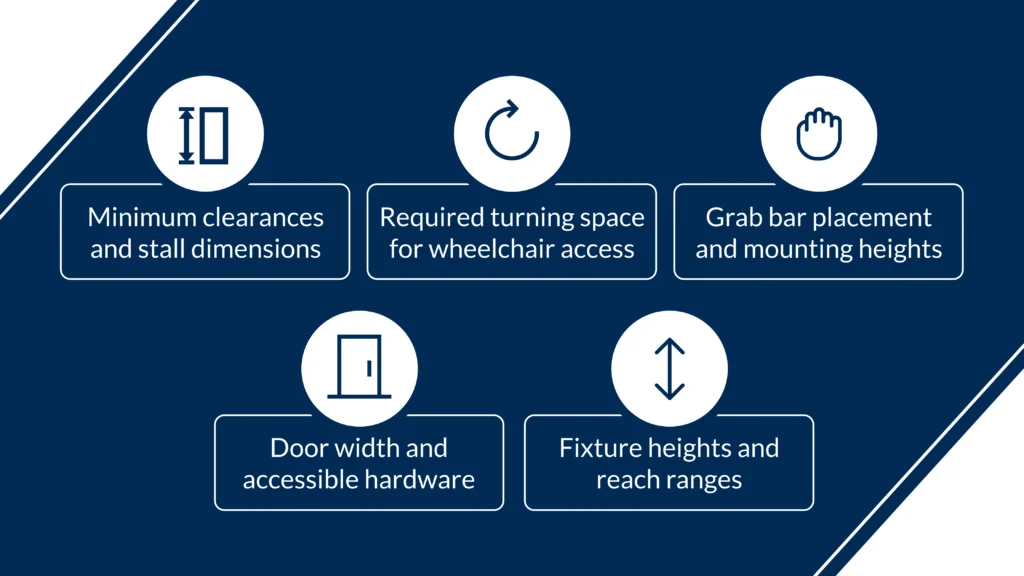
- Minimum clearances and stall dimensions: Ensure adequate space for wheelchair entry, positioning, and safe use within the stall
- Required turning space for wheelchair access: Provide enough room for a full turning radius or a compliant T-shaped maneuvering space
- Grab bar placement and mounting heights: Install bars at precise heights and positions to support stability and safe transfer
- Door width and accessible hardware: Maintain proper clear width and use hardware that does not require tight grasping, pinching, or twisting
- Fixture heights and reach ranges: Position sinks, dispensers, and controls within accessible height and reach limits
Each of these elements is defined by specific measurements and installation requirements. Missing even one can result in non-compliance. The following sections break down these standards in detail, helping you apply them correctly in real-world commercial restroom layouts.
Importance of ADA Compliance

Meeting ADA standards is often viewed as a regulatory obligation, but the impact goes far beyond passing inspection. Every decision tied to ADA restroom requirements affects how a space performs, how it is used, and how it reflects on the business behind it.
Legal Risk and Financial Exposure
- Non-compliant restrooms can result in fines, lawsuits, and mandatory corrections
- Small design oversights can escalate into significant legal and financial consequences
- Delays caused by compliance issues can disrupt project timelines and budgets
Operational Efficiency and Project Continuity
- Failed inspections can delay occupancy approvals and building use
- Corrections often involve removing and reinstalling partitions, fixtures, or hardware
- Fixing issues post-construction typically costs more than proper upfront planning
User Accessibility and Experience
- ADA-compliant restrooms support safe, comfortable use for all individuals
- Poor layouts or incorrect installations can limit or prevent accessibility
- Proper design ensures inclusivity and usability in everyday scenarios
Business Reputation and Accountability
- Compliance reflects a commitment to accessibility and responsible design
- Well-executed ADA standards contribute to a positive perception of the business
- Accessible environments demonstrate attention to detail and user needs
ADA Stall Dimensions and Clearance Requirements
Stall layout is one of the most commonly failed areas in commercial restroom design. Small measurement errors or overlooked clearances can lead to non-compliance, even when everything appears correct on a plan. ADA restroom requirements define these dimensions clearly, and they must be followed precisely during both design and installation.
Standard vs. ADA Stall Dimensions
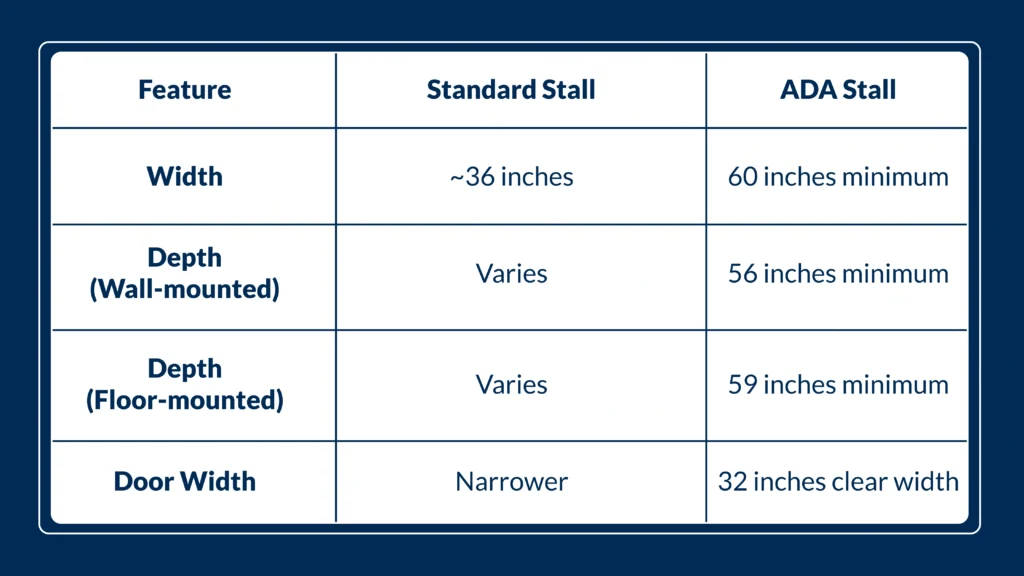
Minimum Stall Width and Depth
Stall size is one of the most strictly defined parts of ADA restroom requirements, and it must be followed exactly.
- Width: A minimum of 60 inches is required to allow proper wheelchair positioning and lateral movement
- Depth:
- 56 inches minimum for wall-mounted toilets
- 59 inches minimum for floor-mounted toilets
The difference in depth accounts for how far the toilet extends into the stall. This extra space ensures there is enough room for safe transfer and maneuvering without obstruction.
Toe Clearance Requirement
Toe clearance is a frequently overlooked detail, but it plays an important role in accessibility.
- Requirement: At least 9 inches of clearance above the finished floor beneath the partition
This space allows the footrests of a wheelchair to extend slightly under the partition, making it easier for users to position themselves comfortably within the stall. Without proper toe clearance, maneuvering space becomes restricted, even if the overall stall dimensions meet requirements.
ADA Partition Clearance
Clearance around partitions is just as important as stall size. ADA partition clearance ensures that users can enter, exit, and use the stall without obstruction.
- Adequate space must be maintained between partitions and surrounding fixtures
- The door swing must not interfere with the required clear floor space
- The partition layout should allow smooth entry and exit without tight angles or blocked access
Incorrect spacing or door placement can compromise the entire layout, even when individual measurements appear compliant. Proper planning ensures all elements work together within the required clearances.
Grab Bar Standards and Mounting Heights
Grab bars are one of the most critical safety features in an accessible restroom, yet they are often installed incorrectly despite clearly defined requirements. Even small deviations in height or placement can result in non-compliance and reduce their effectiveness for users who rely on them for support.
Required Heights
Grab bars must be mounted at a height of 33 to 36 inches above the finished floor. This range ensures that users can comfortably reach and use the bars for balance and transfer. Installing them too high or too low can make them difficult or unsafe to use.
Required Lengths
The length of grab bars is also specified to provide adequate support along key areas of the stall. The rear wall must have a grab bar that is at least 36 inches long, while the side wall requires a longer bar measuring at least 42 inches. These dimensions ensure proper coverage where users need stability the most.
Placement and Positioning Rules
Correct placement is just as important as size. Grab bars must be positioned at precise distances relative to the rear wall and toilet to support safe movement and transfer. Improper spacing or alignment can limit usability, even if the bars meet height and length requirements. Careful attention during installation ensures that all positioning standards are met and the restroom functions as intended.
Wheelchair Turning Space in ADA Restroom Design
Accessibility depends on movement, not just entry. A restroom may meet stall and door requirements, but without proper turning space, it still fails to provide full usability. ADA restroom requirements clearly define how much space is needed for a wheelchair user to turn and navigate comfortably within the room.
60-Inch Turning Circle
The standard requirement is a clear turning space with a 60-inch diameter. This allows a wheelchair to make a full 360-degree turn without obstruction. The space must remain completely clear of fixtures, partitions, or door swings. Even partial encroachment can make the restroom non-compliant.
T-Shaped Turning Space Alternative
When a full circular turning area is not feasible due to layout constraints, a T-shaped turning space can be used as an alternative. This design provides enough room for a three-point turn, allowing users to maneuver within tighter layouts while still meeting accessibility standards.
Common Layout Mistakes
Turning space is one of the most frequently compromised elements in restroom design. These issues usually do not come from missing measurements, but from how different components are arranged within the space.
Common mistakes include:
- Obstructions within the turning area: Trash bins, partitions, or accessories placed within the required clearance reduce usable space
- Improper door swing: Doors that open into the turning radius can block movement and violate clearance requirements
- Poor fixture placement: Sinks, toilets, or dispensers positioned too close together can restrict maneuverability
- Encroaching hardware or accessories: Items like hand dryers or paper towel dispensers can unintentionally interfere with clear floor space
Avoiding these layout issues ensures that the required turning space remains fully functional and compliant.
ADA Door Requirements and Hardware Standards
Door design plays a critical role in accessibility. Even when stall dimensions and clearances meet code, a non-compliant door can prevent proper entry and use. ADA restroom requirements set clear standards for door width, movement, and hardware to ensure ease of access for all users.
Minimum Door Width
Doors must provide a minimum of 32 inches of clear opening width when measured between the face of the door and the stop. This clearance ensures that wheelchair users can enter and exit without restriction. Anything less can make the stall or restroom inaccessible, even if other dimensions are correct.
Door Swing and Clearance
Door swing must be carefully planned to avoid interfering with the required clear floor space. In many cases, doors should swing outward to avoid encroaching into the stall or turning area. The placement must allow users to enter, close the door, and position themselves without obstruction.
Hardware Requirements
Door hardware must be operable without requiring tight grasping, pinching, or wrist twisting. Lever handles, push/pull mechanisms, and other accessible designs are required. Knobs or hardware that require significant force or complex movement do not meet compliance standards. Proper hardware selection ensures ease of use for individuals with limited hand strength or mobility.
How GSS Ensures ADA-Compliant Toilet Partition Installations
Granite State Specialties (GSS) approaches every project as a compliance-driven installation. The team brings hands-on experience working with ADA restroom requirements across a wide range of commercial environments. This includes understanding how measurements translate from drawings to actual job sites, where spacing, mounting conditions, and field adjustments can impact compliance. It provides full privacy toilet partitions for security.
GSS installers are OSHA-trained and familiar with the nuances that often lead to inspection failures. From verifying clearances to aligning partitions with grab bar placement and door swing requirements, each step is handled with precision.
Layout accuracy is a priority from the start. Proper planning ensures that stall dimensions, turning space, and partition positioning all work together without conflict. During installation, attention to detail ensures that measurements are executed exactly as required, reducing the risk of rework or delays.
ADA Restroom Requirements Checklist for Quick Reference
For quick validation during planning or review, use this checklist to confirm your restroom meets essential ADA restroom requirements:
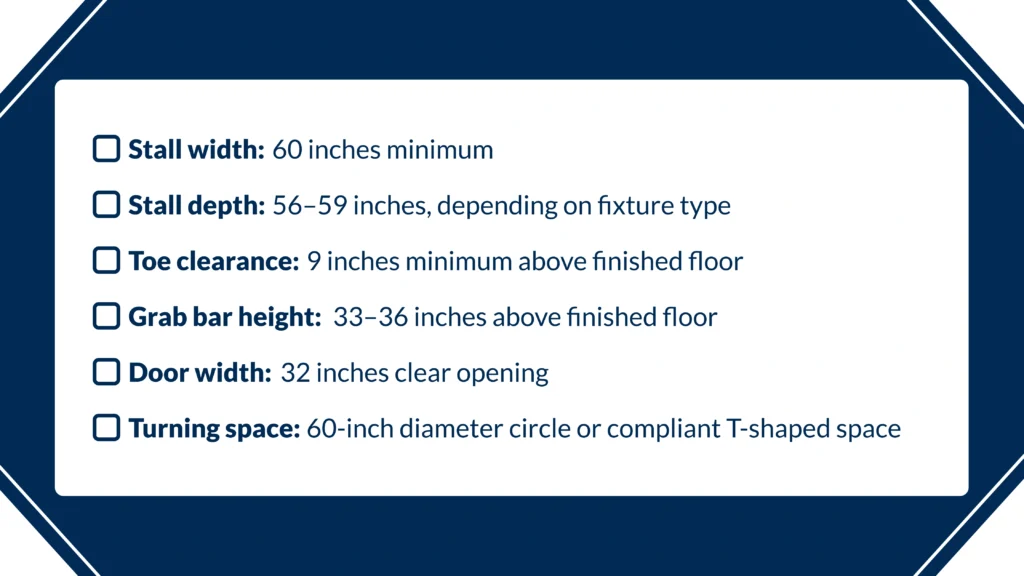
Each of these measurements must be met precisely to ensure full compliance and avoid issues during inspection.
Ensure Your Project Meets ADA Restroom Requirements with Granite State Specialties

ADA compliance is not an area where assumptions or approximations work. Small measurement errors or layout missteps can lead to failed inspections, costly rework, and project delays. Getting it right the first time requires careful planning, accurate specifications, and precise installation.
Granite State Specialties works closely with architects, contractors, and facility managers to deliver restroom partition systems that meet ADA restroom requirements without compromise. Every project is approached with a focus on layout accuracy, code compliance, and real-world performance.
If you are planning a new build or renovation, now is the time to confirm your restroom design meets all required standards. Review your layout, request guidance, and ensure your project is fully compliant before installation begins.
Contact Granite State Specialties!
| Disclaimer This guide provides a comprehensive overview of ADA restroom requirements based on widely accepted standards. However, building codes and enforcement can vary by state, county, or local jurisdiction. Always consult local building inspectors or code officials to verify the specific requirements for your project before finalizing the design or installation. |
Frequently Asked Questions
1. What are the ADA bathroom requirements for commercial buildings?
ADA requirements for commercial buildings cover stall dimensions, clear floor space, door accessibility, grab bar placement, and fixture heights. These standards ensure that restrooms are accessible to individuals with disabilities and must be followed in most public and commercial facilities.
2. Do ADA bathroom requirements apply to residential properties?
ADA standards generally apply to public and commercial spaces, not private residences. However, multi-family housing, senior living facilities, and certain federally funded housing projects may need to follow accessibility guidelines similar to ADA standards.
3. What are the ADA bathroom door requirements?
ADA-compliant restroom doors must provide a minimum clear opening of 32 inches. The hardware must be operable without tight grasping, pinching, or twisting, and the door swing must not interfere with the required clear floor space.
4. What are the ADA bathroom stall requirements?
ADA stalls must be at least 60 inches wide and 56 inches deep for wall-mounted toilets or 59 inches deep for floor-mounted toilets. They must also include proper grab bar placement, adequate turning space, and required clearances for accessibility.
5. What are the standard ADA bathroom dimensions for commercial spaces?
Commercial ADA restroom dimensions include a 60-inch turning radius, compliant stall sizes, accessible fixture heights, and proper spacing between elements. These dimensions work together to ensure users can safely enter, move within, and use the restroom without restriction.