
A restroom partition might seem like a small specification in a larger project, but it is one of the few elements that faces constant, direct use every single day. Doors are pushed, kicked, and pulled. Surfaces are cleaned repeatedly with chemicals. Moisture builds up in ways that are easy to underestimate during planning. Over time, these everyday conditions start to reveal whether the chosen toilet partition wall material was the right fit or a costly oversight.
Issues rarely appear on day one. Metal can corrode in humid spaces, laminate can weaken with repeated exposure to moisture, and softer materials may wear in high-traffic environments. Each problem leads to the same result: increased maintenance, higher costs, and a restroom that no longer performs as expected.
Choosing the right toilet partition wall material comes down to understanding the environment, not just the price or appearance. A school, office, and gym each demand a different approach. This guide breaks down how materials perform in real conditions, helping you select an option that holds up over time and avoids costly mistakes.
Why Toilet Partition Wall Material Is Never a One-Size-Fits-All Decision
A common mistake in commercial projects is assuming that a single toilet partition wall material can perform equally well across all types of facilities. It may simplify procurement, but it rarely holds up in practice. Restrooms do not operate under uniform conditions, and materials that perform well in one setting can fail quickly in another.
Three everyday stress factors drive that difference.
- Moisture exposure plays a major role in how long partitions last: A dry office restroom creates very different conditions than a gym locker room or pool facility. Materials that absorb moisture or rely on coatings for protection can deteriorate quickly when exposed to humidity or direct water.
- Traffic and abuse levels also vary widely: A corporate office may see controlled, moderate use, while a school or transit hub experiences constant impact, rough handling, and occasional vandalism. Materials that look durable on paper may not maintain their surface or structure under repeated stress.
- Cleaning frequency and chemicals add another layer of pressure: High-traffic facilities often require frequent cleaning with strong disinfectants. Some materials handle this without issue, while others fade, weaken, or degrade over time.
These factors directly affect bathroom stall durability and long-term costs. A material that seems cost-effective upfront can become expensive if it requires frequent repairs or early replacement.
Selecting the right toilet partition wall material requires understanding these real-world conditions first, then choosing a solution built to handle them.
How to Evaluate Toilet Partition Wall Material
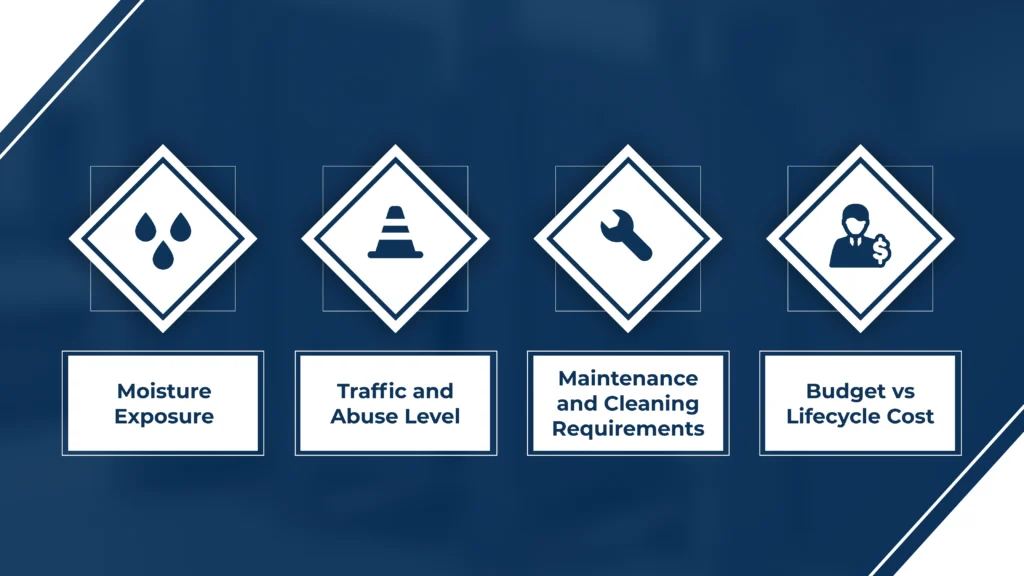
Choosing the right toilet partition wall material starts with a simple question: what will this restroom face every single day? Materials do not fail randomly. They fail when the environment asks more of them than they were built to handle. A clear evaluation upfront prevents that mismatch.
Moisture Exposure
Some restrooms stay dry most of the day. Others deal with constant humidity or direct water contact. That difference changes everything. Materials like powder-coated steel or plastic laminate can perform well in dry environments, but prolonged exposure to moisture can lead to rust, swelling, or surface breakdown. Solid plastic and phenolic options, on the other hand, are built to handle wet conditions without degrading.
A locker room or pool facility demands a very different toilet partition wall material than a corporate office restroom. Ignoring that difference often leads to early replacement.
Traffic and Abuse Level
Traffic is not just about how many people use the space. It also reflects how the partitions are treated. Schools, stadiums, and transit hubs see constant use, frequent impact, and occasional vandalism. Materials in these environments must resist dents, scratches, and surface damage over time.
Lighter-use environments can accommodate more design-focused materials, but high-traffic spaces require durability first. This is where choices like phenolic or solid plastic consistently outperform softer or coated options.
Maintenance and Cleaning Requirements
Cleaning routines vary widely across facilities. Some restrooms are cleaned once a day, while others require multiple cleanings with strong disinfectants. Certain materials handle repeated chemical exposure without issue, while others begin to fade, weaken, or lose their finish.
Ease of cleaning also affects long-term maintenance. A toilet partition wall material that resists staining, graffiti, and chemical damage reduces labor and keeps the space looking consistent over time.
Budget vs Lifecycle Cost
Upfront pricing often drives decisions, but it rarely tells the full story. Lower-cost materials can require more frequent repairs or replacement, increasing the overall cost of toilet partitions across the life of the facility.
A more durable material may carry a higher initial price, but it often delivers better long-term value. The right choice balances budget with expected performance, not just installation cost.
Selecting the Right Toilet Partition Wall Material for Your Environment
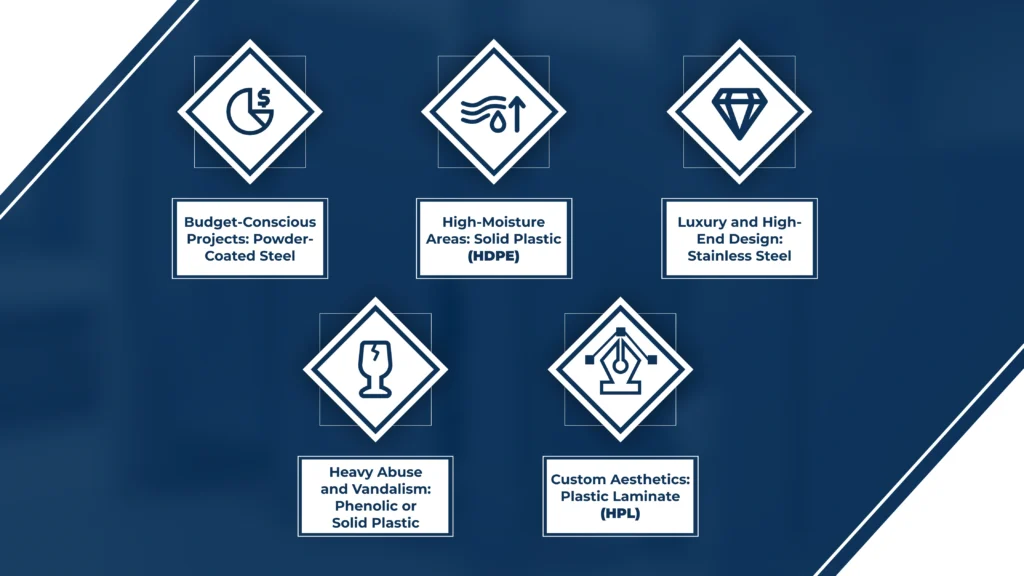
Each material category serves a specific purpose. The goal is not to find a universal solution, but to match the toilet partition wall material to the space’s demands.
Budget-Conscious Projects: Powder-Coated Steel
Powder-coated steel remains one of the most widely used options in commercial restrooms. It offers a low upfront cost and is readily available across standard configurations.
This material works well in dry, controlled environments such as office buildings or low-traffic retail spaces. It delivers a clean appearance and meets basic performance expectations when moisture exposure is limited.
Challenges begin when conditions shift. Humidity and direct water exposure can lead to rust over time. The surface is also more prone to dents and scratches compared to solid materials.
Best fit: Projects where cost is the primary driver and environmental conditions are controlled.
High-Moisture Areas: Solid Plastic (HDPE)
Solid plastic, commonly HDPE, is a reliable choice for environments where moisture is unavoidable. It does not absorb water, will not rust, and can be cleaned with minimal effort.
This makes it a strong option for gyms, aquatic centers, and shower facilities. It also aligns with sustainability goals due to its recycled content, which can support green building initiatives.
There are trade-offs. HDPE is softer than some alternatives, so it can show scratches over time. Graffiti may also leave a faint “ghosting” effect even after cleaning.
Best fit: Restrooms exposed to constant moisture where durability against water matters most.
Luxury and High-End Design: Stainless Steel
Stainless steel partitions bring a refined, modern appearance to commercial restrooms. They are often selected for prestige environments where aesthetics carry as much weight as performance.
The material offers strong corrosion resistance and maintains structural integrity over time. It also qualifies for high fire-performance classifications under building codes.
However, stainless steel is more expensive and requires regular maintenance to maintain its appearance. Fingerprints, smudges, and minor scratches are more visible compared to other materials.
Best fit: Corporate headquarters, upscale hospitality, and design-focused spaces.
Heavy Abuse and Vandalism: Phenolic or Solid Plastic
High-traffic environments demand materials that can handle constant impact and surface abuse. Phenolic (compact laminate) and solid plastic partitions are built for this level of use.
Phenolic offers a dense, hard surface that resists dents, scratches, and graffiti. It performs well in both dry and wet conditions and can achieve strong fire ratings under building codes. Solid color reinforced composite (SCRC) options provide similar durability with the added benefit of repairable surfaces.
These materials maintain their appearance longer in environments where other options would show visible wear.
Best fit: Schools, transportation hubs, and recreational facilities where durability is non-negotiable.
Custom Aesthetics: Plastic Laminate (HPL)
Plastic laminate partitions are often chosen for their design flexibility. They offer a wide range of colors, textures, and patterns, making them suitable for spaces where visual consistency matters.
They also come at a relatively lower cost compared to premium materials. However, laminate is more sensitive to moisture. Prolonged exposure can lead to swelling or delamination, especially at edges.
Best fit: Offices, restaurants, and retail environments where aesthetics are a priority and moisture is controlled.
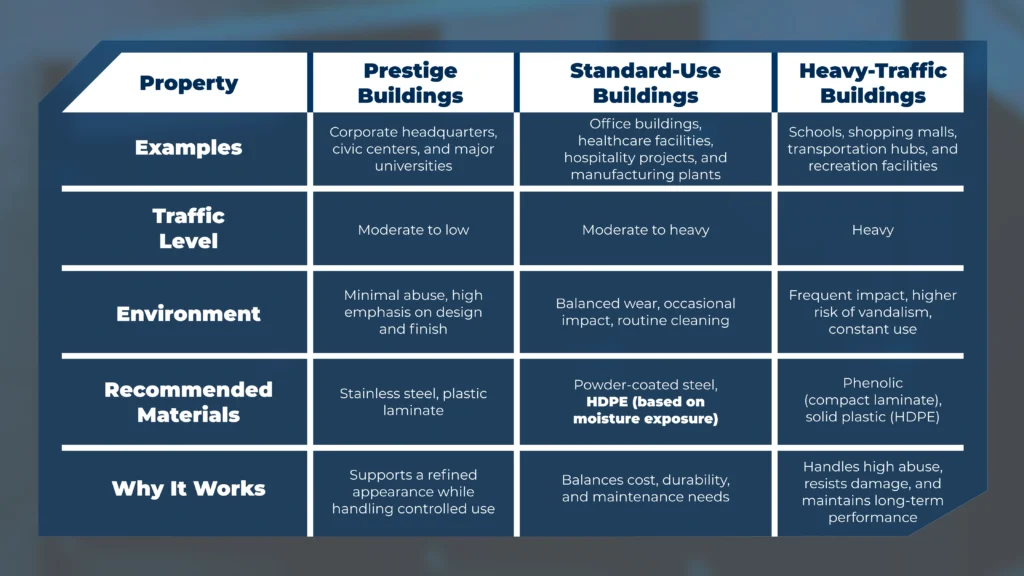
Matching Toilet Partition Wall Material to Building Type
The type of building sets the baseline for selecting the right material for toilet partition walls. Each environment brings different expectations around traffic, durability, and appearance.
Fire Code and Compliance Considerations for Toilet Partition Wall Material
Material selection is not only about performance. It must also meet fire and building code requirements. Modern codes treat restroom partitions as interior finishes, bringing them under the scope of standards such as the International Building Code (IBC) and NFPA guidelines.
Specifiers should look for compliance with recognized testing standards, such as:
- ASTM E84 — Standard Test Method for Surface Burning Characteristics of Building Materials (ASTM International)
- UL 723 — Standard for Test for Surface Burning Characteristics of Building Materials (Underwriters Laboratories)
- NFPA 286 — Standard Methods of Fire Tests for Evaluating Contribution of Wall and Ceiling Interior Finish to Room Fire Growth (National Fire Protection Association)
These tests evaluate flame spread and fire performance, which can vary significantly across materials.
Some materials, such as phenolic and stainless steel, can achieve higher fire classifications. Others require careful verification to ensure compliance. Requesting proper documentation before specifying a toilet partition wall material helps avoid delays and ensures the project meets required safety standards.
Maintenance Profiles: What to Expect From Each Material Over Time
Each toilet partition wall material comes with its own cleaning requirements and durability profile.
Powder-coated steel is easy to clean but may require repairs if rust or surface damage develops. HDPE allows for simple washdown cleaning and resists most chemicals, making it a low-maintenance option in wet environments.
Stainless steel maintains its structure well but requires regular wiping to preserve its appearance. Phenolic surfaces resist graffiti, scratches, and chemicals, reducing ongoing maintenance effort. Laminate partitions need more careful cleaning to prevent moisture damage and surface wear.
Choosing a material that aligns with the facility’s maintenance routine can significantly reduce long-term costs.
Choosing the Best Material for Public Bathrooms
There is no single answer to the question of the best material for public bathrooms. The right choice depends on how the space is used, how often it is cleaned, and how much wear it experiences over time.
A gym, a school, and a corporate office each require a different approach. In some cases, a mixed-material strategy makes sense, using more durable materials in high-stress areas and cost-effective options where conditions are controlled.
The goal is to match the toilet partition wall material to the environment, not to force a single solution across all spaces.
Make the Right Material Choice for Your Project with Granite State Specialties

Material decisions in commercial restroom projects are often made early, and they are difficult to change later. Getting the specification right from the start reduces maintenance issues, avoids premature replacement, and ensures the space performs as intended.
Depending on where your new partitions will be installed, the right material will vary. The most commonly specified options include:
- Powder-coated metal partitions
- Solid HDPE plastic partitions
- Solid phenolic partitions
- Plastic laminate partitions
- Stainless steel partitions
- Corian solid surface partitions
- Glass bathroom partitions
Each of these brings a different balance of durability, aesthetics, moisture resistance, and cost. The right choice is rarely obvious without understanding the full picture of how the space will be used, maintained, and what codes it needs to meet.
That is where Granite State Specialties comes in. GSS works with contractors, property owners, and facility managers to evaluate real-world conditions and match the right material to each project. With hands-on experience across a wide range of commercial environments, the team turns what can feel like a complicated specification decision into a clear, confident one.
Stop guessing on specifications that will define your restroom’s performance for years to come. Get expert guidance on every partition decision with GSS Partitions.
Request a quote from Granite State Specialties today.
Frequently Asked Questions
1. What is the price of toilet partition wall material?
The price varies by type. Powder-coated steel is typically the most budget-friendly, while stainless steel and phenolic options cost more. Solid plastic usually falls in the mid-range but offers strong long-term value due to durability and low maintenance.
2. Where can I find toilet partition wall material near me?
You can source materials through commercial restroom suppliers and specialized contractors. Working with an experienced provider helps ensure proper selection, accurate measurements, and compliance with building requirements.
3. What is the thickness of toilet partition walls in mm?
Most partitions range between 12 mm and 25 mm, depending on the material. Thicker options like solid plastic and phenolic provide added strength, while metal and laminate systems may use thinner panels with internal support.
4. What is the difference between PVC bathroom partitions and other materials?
PVC partitions are lightweight and moisture-resistant, but they are less durable than options like solid plastic or compact laminate. They are better suited for lighter-use environments rather than high-traffic commercial spaces.
5. How do I choose the right toilet partition board for my project?
Start by evaluating moisture exposure, traffic levels, cleaning frequency, and budget. Matching these factors to the right material helps ensure better performance, lower maintenance, and longer service life.