
Every day, hospitals work tirelessly to reduce the risk of healthcare-associated infections (HAIs). From hand hygiene protocols to rigorous cleaning procedures, countless measures are in place to protect patients and staff.
Yet some of the most frequently touched surfaces in a healthcare facility can easily fly under the radar. Hospital privacy curtains are opened, closed, and handled dozens of times each day by healthcare workers, patients, and visitors, often without receiving the same attention as other high-touch surfaces.
That matters because the CDC estimates that approximately 1 in 25 hospitalized patients develops at least one healthcare-associated infection on any given day, making infection prevention a constant priority for healthcare facilities.
So where do privacy curtains fit into that equation?
That’s why one of the most common questions facility managers and infection control officers ask is: How often should hospital curtains be changed?
The answer directly affects your facility’s compliance standing, patient safety outcomes, and ability to pass accreditation surveys, making it far more than a housekeeping question.
For healthcare facility management teams responsible for infection prevention and regulatory compliance, this blog provides a practical, risk-based framework for establishing curtain change frequencies that support both patient safety and operational readiness.
Why Hospital Curtains Are a Serious Infection Risk
Privacy curtains occupy a unique and dangerous position in the healthcare environment. They are high-touch surfaces, handled constantly by clinicians, patients, and families, yet they are rarely included in daily environmental cleaning rounds.
Research published in peer-reviewed infection control journals has confirmed that hospital curtains can harbor dangerous pathogens, including:
- MRSA (Methicillin-resistant Staphylococcus aureus)
- VRE (Vancomycin-resistant Enterococci)
- C. difficile (Clostridioides difficile)
- Gram-negative bacteria with multi-drug resistance profiles
Because curtains function as fomites, inanimate objects capable of transmitting infection, a contaminated curtain pulled aside by a nurse or physician can transfer pathogens to hands, gloves, and ultimately to patients. Without a disciplined hospital curtain hygiene protocol, curtains become a silent vector in your infection control program.
| Hospital curtains are touched far more often than they are cleaned. Without a documented hygiene protocol, they become a silent reservoir for healthcare-associated infections. |
What CDC & Accreditation Standards Recommend
The CDC Guidelines for Environmental Infection Control in Health-Care Facilities do not prescribe a single universal curtain replacement frequency. Instead, they establish that textiles and privacy curtains should be cleaned when visibly soiled and managed in accordance with the facility’s broader environmental infection control policy.
The Joint Commission (TJC) takes a similar approach: your facility must have a documented, consistently followed policy. What TJC surveyors look for is not a specific number of days between changes, but evidence that:
- A written infection control policy governs curtain maintenance
- Staff are trained and follow that policy
- Documentation, such as a curtain log, demonstrates compliance over time
- High-risk areas receive heightened attention
Therefore, there is no single universal “change every X days” rule. Facilities must establish a documented, risk-stratified curtain hygiene program and apply it consistently.
How Often Should Hospital Curtains Be Changed? A Risk-Based Framework
The correct answer to how often hospital curtains should be changed is: it depends on the department’s risk level, patient population, and exposure to contamination. The table below provides a practical starting framework for building your cubicle curtain maintenance schedule.
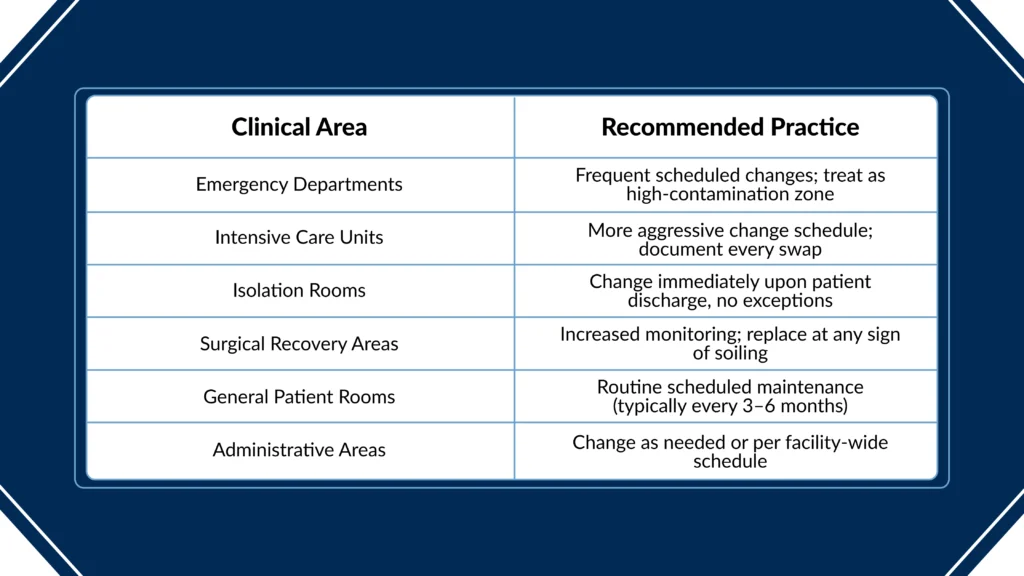
Each of these categories carries different contamination risk profiles. The sections below explain the clinical rationale behind the recommended frequency for your highest-risk areas.
High-Risk Areas Require More Frequent Curtain Changes
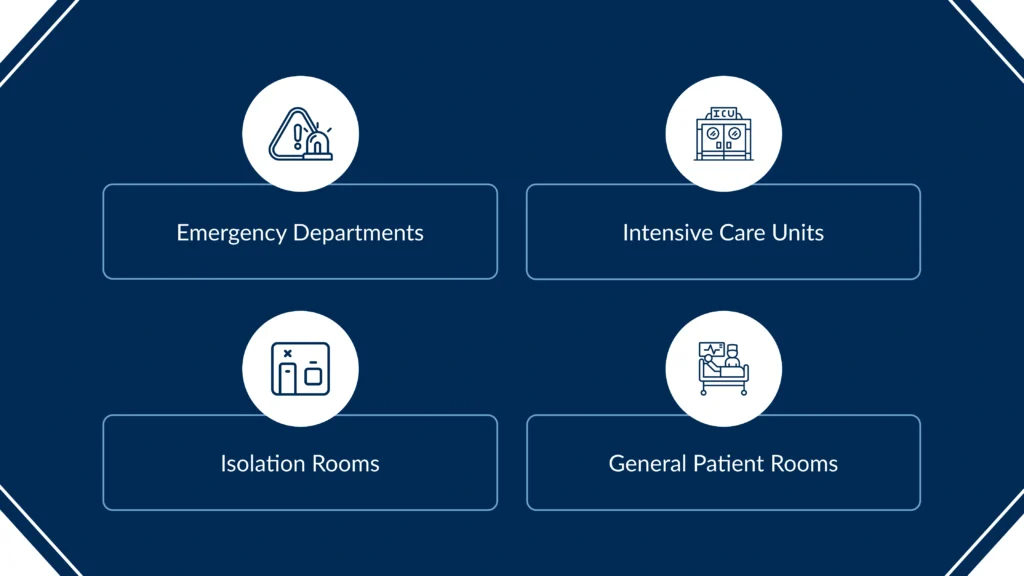
Did you know that all hospital spaces carry the same contamination risk? Curtain change frequency should be based on patient acuity, traffic levels, and infection control requirements. Here are a few sections of a hospital that require more attention.
Emergency Departments
Emergency departments are among the highest-risk environments for curtain contamination. High patient turnover, unknown infection status on arrival, and constant curtain handling by staff and family members make EDs particularly vulnerable. Your infection control policy for the ED should include scheduled curtain changes on a defined, frequent interval, not simply “when visibly soiled.”
Intensive Care Units
ICU patients are among the most immunocompromised in your facility. Combined with the frequency of curtain contact during procedures and care activities, this makes ICUs a priority for aggressive hospital curtain hygiene practices. Many facilities establish bi-monthly or monthly change schedules for ICU bays, with immediate changes in response to any suspected contamination.
Isolation Rooms
Isolation rooms require immediate curtain replacement upon patient discharge, no exceptions. This is non-negotiable from an infection control standpoint. Curtains that remain in place after an isolation patient’s discharge represent a direct cross-contamination risk for the next occupant. This requirement should be explicitly written into your facility’s infection control policy and tracked in your curtain log.
General Patient Rooms
For standard inpatient rooms with lower-acuity populations, a routine maintenance interval of every 3 to 6 months is commonly adopted. However, this baseline should be reassessed at least annually and adjusted if outbreak events or accreditation findings indicate a need for more frequent changes.
The Curtain Laundering vs. Replacement Decision
Once you’ve determined ’how often should hospital curtains be changed’ in each department, you face a second decision: should soiled or scheduled curtains be laundered and returned, or replaced with new curtains? Both approaches are valid components of a hospital curtain hygiene program. The right choice depends on your facility’s operational capacity, budget, and room turnaround requirements.
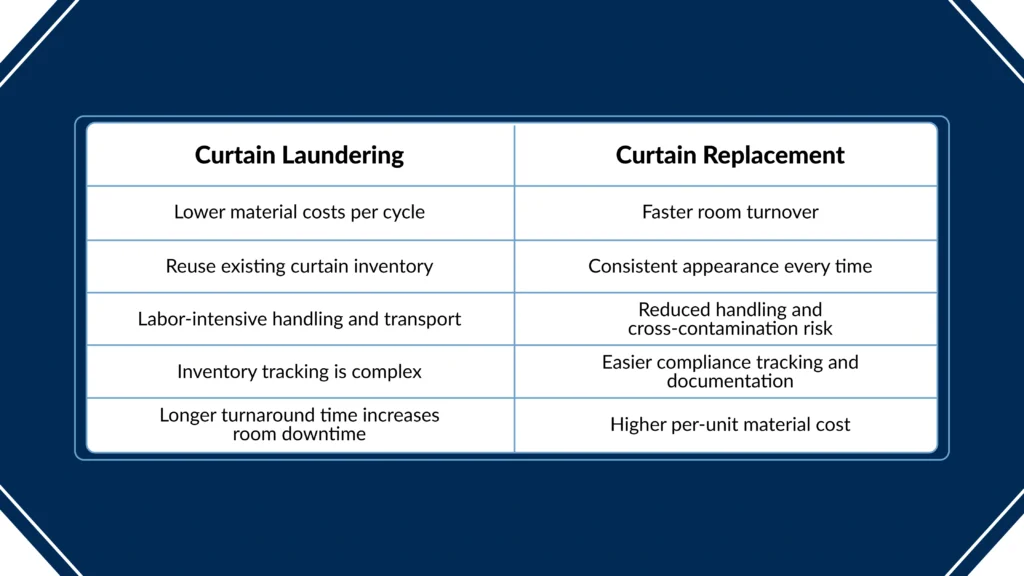
Many larger health systems use a hybrid approach: routine interval changes involve laundering and reuse, while isolation room discharges and visible contamination events trigger immediate replacement of curtains. Whatever approach your healthcare facility management team selects, the critical requirement is that the policy is written, followed, and documented.
Why Easy-Change Curtain Systems Are Vital to Your Maintenance Program
The operational reality of curtain maintenance is that it occurs consistently only when it’s easy to execute. That’s why the design of your curtain system matters as much as the policy behind it. Granite State Specialties cubicle curtain systems are engineered with quick-change carriers that allow staff to swap curtains in minutes without ladders, tools, or extended room downtime.
For healthcare facility management teams, this translates directly into compliance benefits:
- Faster curtain swaps mean rooms return to service more quickly
- Reduced handling minimizes secondary contamination during the change process
- Staff can execute curtain changes without specialized equipment or training overhead
- Consistent curtain appearance supports accreditation survey readiness
When curtain changes are quick and simple, staff actually perform them on schedule. When they require scaffolding, multiple personnel, or significant disruption to the room, they get deferred, and your cubicle curtain maintenance schedule breaks down.
The Curtain Log: Your Most Important Compliance Document
“If it isn’t documented, it didn’t happen.” This principle holds true in every TJC accreditation survey, and it applies directly to your curtain maintenance program. A curtain log, whether paper-based or integrated into your environmental services software, is the documentary evidence that your infection control policy is being followed.
What Your Curtain Log Should Capture
- Room location and bed number
- Curtain installation or most recent laundering date
- Scheduled next change date based on department protocol
- Date of any unscheduled change and the reason (visible soiling, isolation discharge, etc.)
- Staff member responsible for the change
- Notation for isolation room discharges specifically
During a TJC survey, environmental services staff may be asked directly how they know when curtains were last changed. A well-maintained log, consistently applied across departments, is the only defensible answer. Facilities that rely on memory or informal “we do it regularly” statements routinely receive findings during infection control reviews.
Hospital Curtain Maintenance Log Template Need a simple way to document curtain changes, laundering schedules, and isolation room replacements? Download our Hospital Curtain Maintenance Log Template to help your facility: Track scheduled and unscheduled curtain changesDocument laundering and replacement activitiesSupport infection control audits and accreditation surveysMaintain a consistent, facility-wide curtain maintenance program Download the PDF Template → |
A 5-Step Framework for Building Your Hospital Curtain Maintenance Schedule
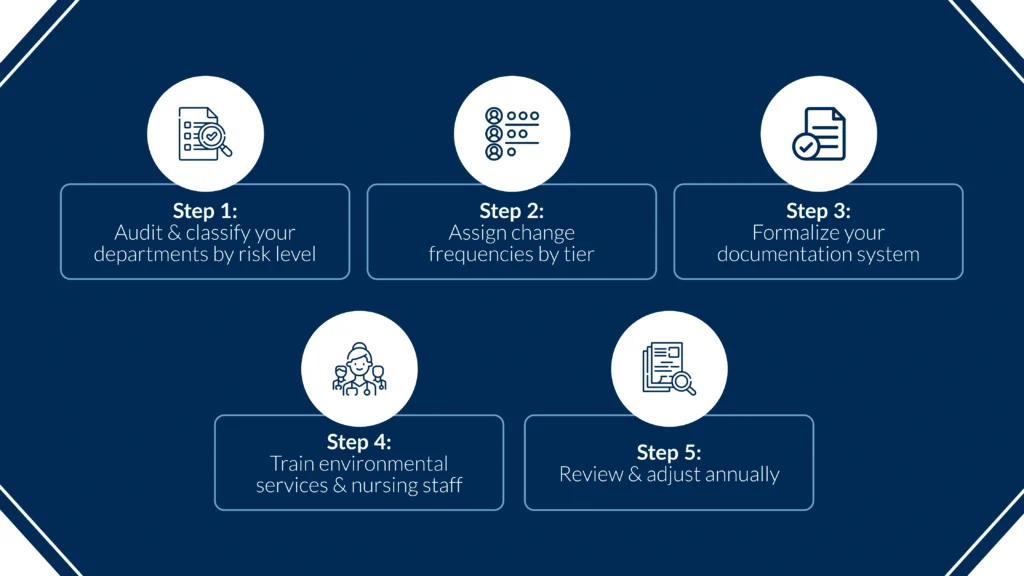
Translating the guidance above into an operational cubicle curtain maintenance schedule requires a structured implementation process. Use the following framework as your starting point:
Step 1. Audit & classify your departments by risk level: Map every curtained space in your facility and assign a risk tier based on patient acuity, infection status exposure, and throughput volume.
Step 2. Assign change frequencies by tier: Set defined intervals for each risk category, for example: ICU monthly, general wards every 4 months, isolation rooms upon every discharge. Document these in your infection control policy.
Step 3. Formalize your documentation system: Implement a curtain log, either within existing environmental services tracking software or as a dedicated physical log, for every curtained room.
Step 4. Train environmental services & nursing staff: Ensure all personnel who may initiate a curtain change understand the protocol, documentation requirements, and escalation process for unexpected contamination events.
Step 5. Review & adjust annually: Evaluate your change frequencies at least once per year using outcome data, including HAI rates by unit, TJC findings, and feedback from nursing leadership and infection control officers.
Keep Your Maintenance Program Simple & Efficient With Granite State Specialties
A successful curtain hygiene program depends on more than replacement frequency. It requires durable products, efficient change-out systems, and a maintenance process that staff can follow consistently under real-world conditions.
Granite State Specialties helps hospitals, healthcare systems, and long-term care facilities implement privacy curtain solutions engineered for infection control, operational efficiency, and regulatory compliance. Whether you’re updating an existing program or specifying a new facility, GSS can help you build a system that’s faster to maintain and easier to document.
Is your curtain maintenance policy up to code? Contact Granite State Specialties for expert guidance on durable, easy-to-manage healthcare privacy curtain systems.
FAQs
1. How often should hospital curtains be changed?
Hospital curtains should be changed according to a documented, risk-stratified facility policy. At a minimum, they must be changed when visibly soiled, immediately upon the patient’s discharge from the isolation room, and at scheduled intervals determined by the department’s risk level. There is no single universal timeline; the frequency should reflect the clinical environment of each area.
2. How often should hospital curtains be washed?
Laundering frequency mirrors replacement frequency and should be governed by the same risk-based policy. High-acuity departments such as ICUs and EDs require more frequent laundering than lower-risk general patient rooms. Many facilities treat isolation discharge events as automatic replacement, rather than launder, events to eliminate turnaround delays.
3. Do antimicrobial curtains eliminate the need for curtain changes?
No. Antimicrobial curtains, as discussed in detail in our related article on the scientific benefits of antimicrobial hospital curtains, provide an additional layer of infection control by inhibiting microbial growth on the fabric surface. They do not eliminate the need for scheduled laundering and replacement. Antimicrobial properties degrade over time and wash cycles, and visible soiling or isolation discharge events still require immediate curtain changes regardless of curtain type.
4. What is the best hospital curtain maintenance schedule?
The best schedule is one that is risk-stratified by department, formally documented in your infection control policy, consistently executed by trained staff, and tracked through a curtain log. There is no single correct answer; a policy designed around your facility’s specific patient population and operational capacity will always outperform a generic template.
5. Should hospitals keep records of curtain changes and laundering?
Yes. Maintaining a curtain log is considered a best practice for healthcare facilities. Documentation should include installation dates, laundering schedules, replacement records, and isolation room change-outs. During accreditation surveys and infection control audits, these records help demonstrate that curtain maintenance is being managed consistently and in accordance with the facility’s infection control policy.