
Every minute counts when a building catches fire. Yet one of the most critical lines of defense, the fire door, is often overlooked until it’s too late. According to the U.S. Fire Administration, nonresidential building fire deaths increased by 70% over the past decade. That’s not just a compliance problem. It’s a design and maintenance failure.
A fire door looks like any other door. That’s exactly what makes it so easy to underestimate. But beneath the surface, it’s a precisely engineered system, and when even one component is missing or incorrectly installed, the entire assembly can fail under fire conditions.
For facility managers, contractors, and safety professionals, understanding how a fire door actually works isn’t optional. It’s the foundation of every compliant, occupant-safe building.
What Is a Fire Door?
A fire door is a fire-rated assembly that resists the spread of fire and smoke for a specified period, typically 30, 60, 90, or 120 minutes. Unlike a standard door, fire-rated doors function as an active safety system, not just a physical barrier.
The Components of a Fire Door Assembly
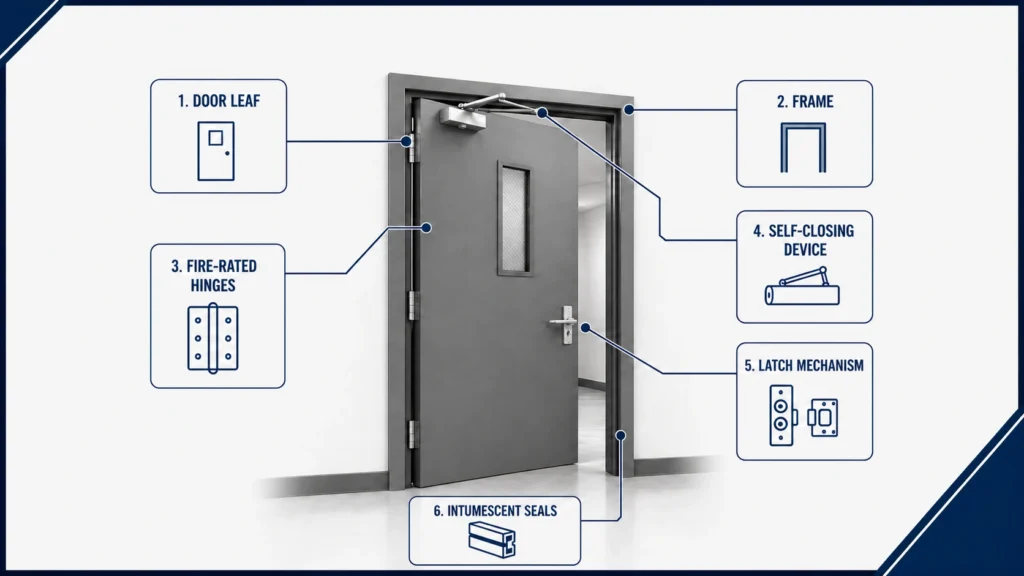
A fire door is only as effective as its components. Every element is tested and certified together as a complete unit; replacing or modifying any single component without proper approval can compromise the entire assembly.
- Door Leaf: The main visible panel, manufactured from fire-resistant materials and certified to withstand heat and flames for its rated duration.
- Frame: Anchors the system to the surrounding wall structure, supports the door leaf, and maintains a secure seal between the two. It must be made from approved materials and correctly installed to preserve the fire rating.
- Fire-Rated Hinges: Carry the weight of the door while allowing smooth, reliable movement. Built to remain stable under high temperatures, keeping the door properly aligned during a fire.
- Self-Closing Device: Returns the door to the closed position automatically after use. This is non-negotiable; an open fire door cannot contain fire or smoke, regardless of its rating. Hence, self-closing fire doors are a must.
- Latch Mechanism: Keeps the door firmly shut, eliminating gaps that could allow smoke and flames to pass through. Engineered to function reliably even under emergency conditions.
- Intumescent Seals: Fitted around the door or frame edges and remain inactive during normal use. When exposed to high heat, they expand significantly to seal gaps and block the passage of fire, smoke, and toxic gases.
How Does a Fire Door Work?
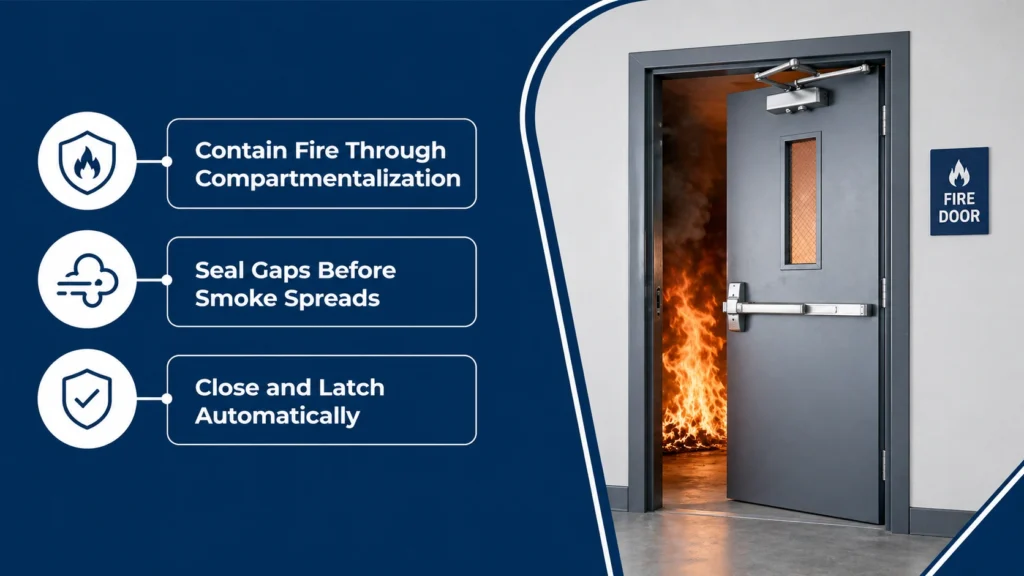
Here’s how a fire door works:
Contain Fire Through Compartmentalization
The core principle behind every fire door. When a fire breaks out, the closed door confines flames and smoke to a specific area, slowing their spread and giving occupants critical time to evacuate safely.
Seal Gaps Before Smoke Spreads
As temperatures rise, intumescent seals expand to close the gap between door and frame, the point most vulnerable to smoke infiltration, maintaining a sealed barrier on the protected side.
Close and Latch Automatically
A hydraulic door closer returns the door to the closed position after each use. The latch then holds it securely shut, preventing heat pressure or air movement from forcing it open. Together, these ensure the door performs without any human intervention.
What are Fire Door Ratings?
Not all fire doors provide the same level of protection. Fire door ratings indicate how long the assembly can withstand fire exposure under standardized testing conditions. Common ratings include:
- 20-minute rating: This rating is commonly used in corridors, office spaces, and low-risk areas where basic compartmentalization is needed. It helps slow the spread of smoke and flames while maintaining safer evacuation paths for building occupants.
- 45-minute rating: A 45-minute fire door is often installed in moderate-risk zones such as tenant separations, service areas, or access points between different functional spaces. It provides stronger protection where fire exposure risks are slightly higher.
- 60-minute rating: This level is used in more critical areas that require additional fire resistance, such as utility rooms, storage areas, and sections of buildings with increased occupant density. It offers extended protection and stronger containment.
- 90-minute rating: A 90-minute fire door is required in high-risk environments such as stairwells, mechanical rooms, electrical rooms, and areas that connect to major exit routes. These doors are built for maximum fire containment where safety risks are greatest.
The required rating depends on building codes, occupancy type, and the level of risk associated with the space. Selecting the correct rating is essential for maintaining compliance and ensuring safety.
Common Locations for Fire Doors
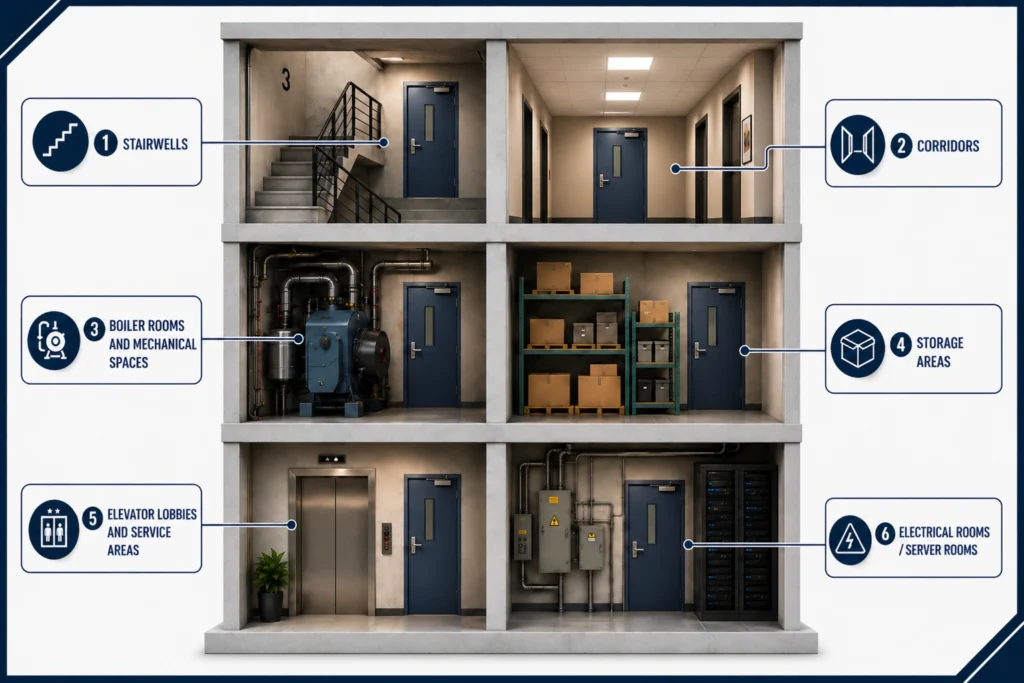
A fire door is strategically placed in areas where controlling fire spread is critical. These locations are chosen based on how people move through the building and where fire risks are highest.
Common locations include:
- Stairwells: The primary vertical escape route in any multi-story building; a fire door here keeps the path clear of smoke and flames when occupants need it most.
- Corridors: High-traffic arteries that connect building sections; fire doors divide these zones to slow the spread and preserve safe passage during evacuation.
- Boiler rooms and mechanical spaces: Concentrated heat sources and pressurized systems make these among the highest-risk areas in any commercial building.
- Storage areas: Combustible inventory and limited airflow create conditions where fire can escalate quickly and with little warning.
- Elevator lobbies and service areas: Vertical shafts act as natural chimneys, drawing smoke upward through floors; fire doors here prevent the entire building from becoming a flue.
- Electrical Rooms / Server Rooms: High concentrations of wiring, electrical panels, and heat-generating equipment make these spaces vulnerable to fire risks. Fire doors help contain potential electrical fires and prevent smoke from spreading to occupied areas of the building.
Why Fire Doors Should Never Be Propped Open
One of the most common safety violations is propping a fire door open. While it may seem convenient for ventilation or accessibility, it completely defeats the purpose of the system.
A fire door only works when it is closed. When wedged open:
- Fire and smoke can move freely between compartments
- Escape routes may become unsafe for occupants trying to evacuate
- Smoke can spread faster than flames, increasing life safety risks
- The building may fail inspections or violate fire code requirements
- Property damage and liability exposure can increase significantly
In many jurisdictions, this is considered a serious safety violation. If doors must remain open during normal operation, they should be equipped with approved hold-open devices that release automatically when a fire alarm is triggered.
Inspection Requirements For Fire Doors
Fire doors are subject to strict maintenance standards.
All fire door assemblies must be inspected at least annually in accordance with the requirements of NFPA 80.
Regular inspections ensure that components function correctly and that the door will perform as expected during an emergency. For more information, refer to NFPA 80.
Proper installation is just as important as selecting the right fire safety products. Even certified fire-rated systems can fail if they are not installed correctly or maintained to code requirements. Granite State Specialties (GSS) brings extensive expertise in commercial fire protection systems, helping businesses install and maintain code-compliant solutions with confidence
Protect Your Building with Expert Fire Safety Solutions from GSS
Granite State Specialties (GSS) delivers complete fire safety solutions for commercial and industrial buildings, from accurate frame and hardware alignment to correct gap tolerances and full integration with building safety systems.
Getting installation details right isn’t just about passing inspections. It’s what separates a fire door that performs under pressure from one that fails when it matters most. Overlooking even minor compliance requirements can turn a critical safety feature into a serious liability.
GSS fire safety solutions brings the expertise to make sure that never happens.
Protect your occupants and your assets. Contact GSS today for a quote on high-quality fire door assemblies.
FAQs
1. Can fire doors be painted or modified after installation?
Fire doors should not be modified without the manufacturer’s approval. Drilling holes, changing hardware, trimming edges, or applying certain coatings can affect the fire rating and compromise compliance. Even small changes can impact how the door performs during a fire.
2. Do fire doors need special signage?
Yes, many fire doors require specific signage such as “Fire Door Keep Shut” or “Automatic Fire Door Keep Clear,” depending on local fire codes and building requirements. Proper signage helps occupants understand the door’s purpose and prevents unsafe use.
3. Who is responsible for maintaining commercial fire doors in a building?
Building owners, facility managers, and property managers are typically responsible for ensuring fire doors remain compliant and functional. This includes scheduling inspections, repairing damaged components, and preventing misuse such as propping doors open.
4. Can damaged fire door seals be replaced separately?
Fire door seals can be replaced, but only with approved fire-rated replacement seals that match the original tested assembly. Using the wrong seal or improper installation can invalidate the fire door’s certification and reduce its effectiveness.
5. What happens if a building fails a fire door inspection?
Failed fire door inspections can lead to code violations, delayed occupancy approvals, increased liability, insurance concerns, and potential fines. More importantly, non-compliant fire doors create serious life safety risks during an actual fire emergency.