
Between 2017 and 2021, U.S. fire departments responded to an average of 36,784 fires per year in industrial and manufacturing properties alone, resulting in injuries, fatalities, and roughly $1.5 billion in annual property damage.
That’s the reality behind every “just-in-case” fire protection decision.
In commercial buildings, fire safety systems aren’t isolated choices; they shape how a space is designed, how it performs under pressure, and how effectively it protects people and assets when something goes wrong.
Which is exactly why the fire curtain vs fire shutter decision matters more than it first appears.
Both systems are built to contain fire and smoke, but they solve very different problems. One is designed for flexibility and seamless integration into modern architecture. The other is built for strength, durability, and high-risk environments. Choosing between them isn’t about preference; it’s about fit.
Get it right, and the system works quietly in the background, aligned with your design, structure, and compliance requirements. Get it wrong, and you’re dealing with structural constraints, design compromises, or performance gaps that show up when it matters most.
This blog breaks down the differences clearly, so you can match the right solution to your building, your constraints, and your fire protection strategy.
What Is a Fire Curtain?
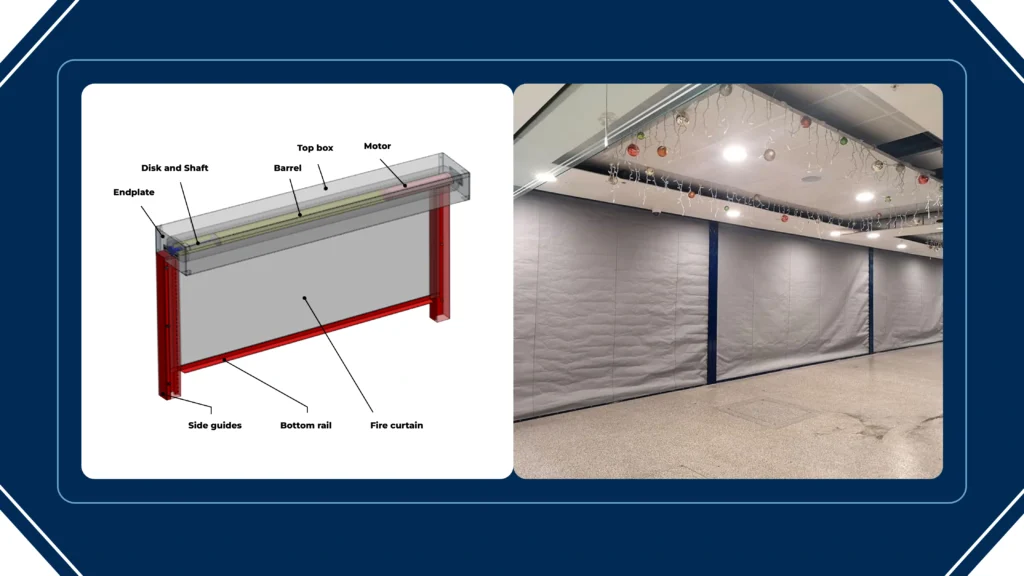
A fire curtain is a flexible fire safety barrier made of fire-resistant fabric that automatically deploys during a fire event to contain flames and smoke. Typically installed within ceilings or headboxes, it remains completely out of sight until triggered by the alarm system.
- Deploys via gravity or motor when triggered by fire alarms
- Designed primarily for smoke containment and compartmentation
- Can cover large, wide, or irregularly shaped openings
- Minimal structural impact due to lightweight construction
Fire curtains are a go-to solution in open architectural spaces where traditional barriers would interfere with design or sightlines.
| Fire Curtain Pros & Cons | |
| Completely concealed; no visual impactLightweight, minimal structural loadCovers large, irregular, or complex openingsIdeal for open-plan, design-led environmentsFaster and simpler to install | No physical security benefitHigher upfront product costNot suited for harsh/industrial environmentsRequires ceiling depth for headbox |
Popular Question | How Does a Fire Curtain System Work? A fire curtain system consists of a fabric barrier stored in a compact headbox mounted at ceiling level, a motor or gravity-release mechanism, guide rails or tracks on either side of the opening, and integration with the building’s fire alarm and detection system. On alarm activation, the curtain deploys, either by gravity drop or motorized descent, sealing the opening and creating a compartment to contain fire and smoke. GSS fire curtain systems are fully tested, code-compliant, and designed for seamless integration with your building’s existing fire protection infrastructure. |
What Is a Fire Shutter?
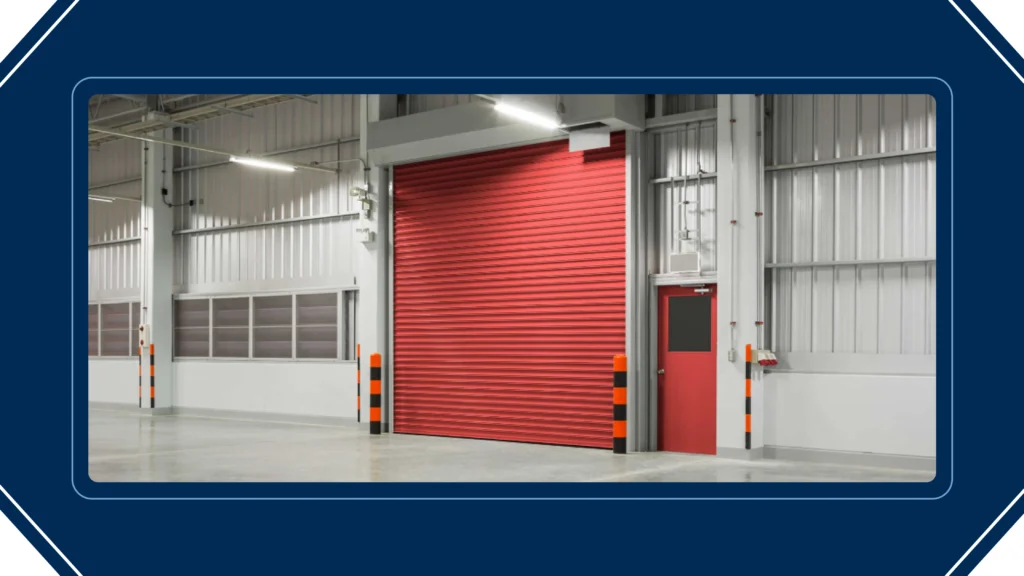
A fire shutter is a rigid, rolling fire door system made from steel slats that descend to seal an opening during a fire. Built from galvanized or stainless steel, shutters are engineered for durability, compartmentation, and in many cases, physical security.
- Constructed from heavy-duty galvanized or stainless steel
- Provides both fire protection and break-in resistance
- Typically installed over doors, windows, or service openings
- Common in industrial, commercial, and high-risk environments
Technical Insight | How Does a Fire Curtain System Work? A fire curtain system consists of a fabric barrier stored in a compact headbox mounted at ceiling level, a motor or gravity-release mechanism, guide rails or tracks on either side of the opening, and integration with the building’s fire alarm and detection system. On alarm activation, the curtain deploys, either by gravity drop or motorized descent, sealing the opening and creating a compartment to contain fire and smoke. GSS fire curtain systems are fully tested, code-compliant, and designed for seamless integration with your building’s existing fire protection infrastructure. |
| Fire Shutter Pros & Cons | |
| Lower upfront product costProvides fire protection + physical securityHighly durable, withstands impact and wearSuitable for industrial and high-risk environmentsEffective for defined, fixed openings | Visible housing, industrial aestheticHeavy, requires structural reinforcementMore complex and costly to installLimited to fixed, regular opening shapes |
Fire Curtain vs Fire Shutter: Fundamental Differences That Impact Design and Performance
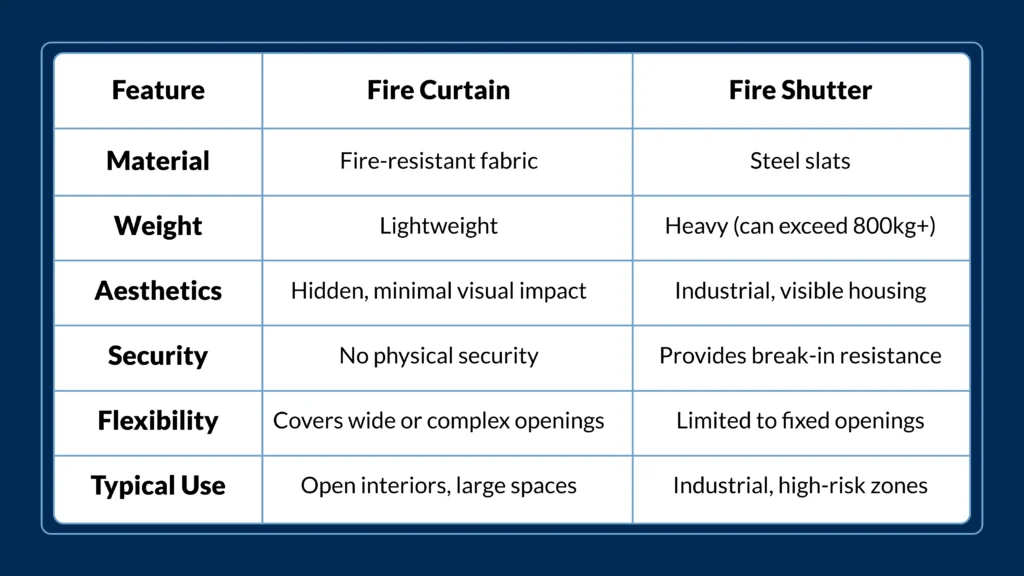
At a glance, both systems serve the same purpose, containing fire and smoke. But when you break down the fire curtain vs fire shutter comparison, the differences quickly become practical, affecting structure, design, and long-term use.
Weight, Space & Structural Impact
This is often the first difference that shows up on-site. Fire curtains are lightweight and designed to fit within compact headboxes, requiring minimal structural support. They integrate easily into ceiling spaces without major design adjustments.
Fire shutters, on the other hand, bring significant weight into the equation. In larger openings, they can exceed a ton, which means additional structural reinforcement, heavier-duty supports, and specialized lifting equipment during installation.
In retrofit scenarios, that added weight can ripple into longer timelines, higher labor costs, and more coordination across trades.
Aesthetics & Architectural Integration
If the project prioritizes design, the contrast is immediate. Fire curtains remain completely concealed until deployed. There are no visible housings or exposed components, which allows architects to maintain clean lines and uninterrupted sightlines. This makes them a natural fit for modern commercial environments where visual continuity matters.
Fire shutters are inherently more visible. Their steel housing and guide systems introduce a functional, industrial look that works well in back-of-house or utility areas, but can feel out of place in refined, design-led spaces.
Durability & Security
This is where fire shutters take a clear lead. Their steel construction allows them to withstand impact, frequent operation, and tougher environmental conditions. They also provide an added layer of physical security, helping deter unauthorized access, which makes them a practical choice for service openings, loading bays, and kitchens.
Fire curtains are purpose-built for fire safety barriers and smoke containment. They perform exceptionally well in that role but are not designed to resist impact or provide security. If physical protection is required alongside fire resistance, shutters are the more appropriate choice.
What This Means in Practice
The fire curtain vs fire shutter decision isn’t about which system is better; it’s about which one fits the conditions of your project.
- Fire curtains solve for design flexibility, space efficiency, and discreet protection
- Fire shutters solve for strength, security, and durability in demanding environments
Understanding these differences early helps avoid costly adjustments later, especially once structural and architectural elements are already in motion.
Fire Curtain vs Fire Shutter: How To Choose the Right System for Performance, Design & Compliance
Selecting between a fire curtain and a fire shutter isn’t a simple side-by-side comparison; it’s a decision that sits at the intersection of design intent, risk profile, structural constraints, and code compliance.
The right choice depends on how the space is used, what it needs to protect, and how seamlessly the system integrates into the building.
Choose a Fire Curtain When
- You’re working with open-concept layouts, atriums, or large, uninterrupted floor plates where traditional barriers would disrupt flow
- Aesthetics and architectural integration are critical, especially in front-of-house or high-visibility spaces
- Openings are wide, tall, or irregular, including corners, curved layouts, or multi-level voids
- The primary objective is smoke containment and compartmentation, rather than physical security
- You need a solution that can remain concealed until deployment, preserving clean sightlines
Ideal environments: Offices, shopping malls, hotel lobbies, stairwells, theatres, cultural spaces
Fire curtains are particularly effective in modern commercial buildings where design flexibility and occupant flow are just as important as fire protection.
Choose a Fire Shutter When
- You require combined fire protection and physical security in a single system
- The opening is a defined aperture such as a doorway, service hatch, or loading bay
- The environment is industrial, high-risk, or exposed to impact, where durability is non-negotiable
- The project prioritizes a lower upfront cost and can accommodate structural requirements
- A visible, robust barrier is acceptable within the overall design
Ideal environments: Warehouses, factories, commercial kitchens, car parks, retail back-of-house, plant rooms.
Fire shutters are best suited for functional zones where performance and resilience outweigh aesthetic considerations.
Cost Considerations
The cost in the fire curtain vs. fire shutter decision extends beyond the product itself.
Fire shutters are generally more cost-effective up front, making them attractive for budget-sensitive projects. Meanwhile, fire curtains, while typically higher in initial cost, can reduce expenses related to:
- Structural reinforcement (due to lighter weight)
- Installation complexity and time
- Design modifications in architecturally sensitive spaces
In large-span or high-design environments, these indirect savings can make fire curtains a more efficient overall investment.
Fire Curtain vs Fire Shutter Price | What Should You Expect? Fire shutters are generally less expensive than other products, making them attractive for straightforward, budget-sensitive applications where structural requirements are already met. Fire curtains typically carry a higher upfront cost, but often reduce total project spend by eliminating the need for structural reinforcement, reducing installation time, and avoiding design modifications in architecturally sensitive spaces. For large-span or high-design environments, the indirect savings from specifying a fire curtain can outweigh the initial price difference. For industrial or back-of-house openings, a fire shutter is usually the more cost-effective choice end-to-end. GSS provides accurate, project-specific pricing for both systems. Contact us for a review of your plans. |
Code Compliance & Fire Safety Standards
Both systems play a critical role in commercial fire-protection strategies and must comply with recognized standards, such as NFPA 80, which governs installation, inspection, and maintenance requirements for fire-rated assemblies.
In practice, both fire curtains and fire shutters are integrated into broader fire protection systems, including:
- Fire alarm and detection systems for automatic deployment
- Smoke control strategies to limit the spread of toxic gases
- Compartmentation planning to protect escape routes and critical areas
Proper specification ensures that these systems function as intended during an emergency, not just on paper, but in real-world conditions.
Work With GSS for Code-Compliant Fire Solutions
Specifying between a fire curtain vs fire shutter isn’t just a product call; it’s a coordination decision that impacts design, structure, and code compliance. Once drawings are locked, revisiting that choice can slow timelines and add unnecessary cost.
Granite State Specialties (GSS) works alongside architects, contractors, and facility teams to make that decision clear from the start. Whether your project calls for discreet smoke containment in an open atrium or heavy-duty fire-rated shutters for a service opening, GSS helps align the right system with your building’s layout and fire protection strategy.
From product selection to installation, the focus stays on performance, compliance, and constructability, so what’s specified on paper works seamlessly on site. While working with us, you get:
- Guidance on fire curtains, rolling fire doors, and fire-rated shutters
- Support with code-compliant fire safety barriers and system integration
- Coordination with project teams from design through installation
- Reliable solutions for commercial fire protection across industries
Unsure which fire barrier fits your project? Connect with Granite State Specialties specialists today.
Frequently Asked Questions
1. How long does a fire curtain or fire shutter take to deploy?
Most fire curtains deploy within 30 seconds of alarm activation, with gravity-drop models descending almost instantly. Motorized fire shutters typically take 30–60 seconds to fully close, depending on the size of the opening. Both systems are tested to confirm deployment speeds meet the relevant fire code requirements.
2. Can a fire curtain or fire shutter be used in an existing building?
Yes, both systems can be retrofitted into existing buildings, though the process differs. Fire curtains are generally easier to retrofit due to their lightweight construction and compact headbox, requiring minimal structural modification. Fire shutters can also be retrofitted, but may require additional structural reinforcement around the opening to carry the load.
3. How often do fire curtains and fire shutters need to be inspected or maintained?
Under NFPA 80 and applicable local codes, fire-rated assemblies, including fire curtains and shutters, must be inspected at least annually, with some jurisdictions requiring more frequent checks. Inspection covers deployment testing, mechanical integrity, guide track condition, and alarm interface verification.
4. Can a fire curtain be specified for an exterior opening or outdoor environment?
Standard fire curtains are designed for interior use and are not suited to direct exposure to weather, UV, or temperature extremes. For exterior or semi-exposed openings, fire shutters are typically the more appropriate solution, given their steel construction and resistance to environmental conditions.
5. What happens to a fire curtain or shutter after it deploys? Can it be reset?
Yes. Both systems are designed to be reset after deployment, though the process varies. Motorized fire curtains can typically be retracted and reset by authorized personnel once the all-clear is given and the system has been inspected. Fire shutters can similarly be raised and reset manually or via motor.