
You may use stairs every day without ever thinking twice about the metal rail your hand brushes on the way up. Yet that handrail, and everyone likes it, is a carefully regulated safety requirement under the International Building Code (IBC). Properly installed handrails help people move safely up and down stairs and along ramps. They provide support during emergencies and reduce the risk of slips and falls in commercial spaces. Missing or poorly installed handrails can lead to failed inspections, liability concerns, and unsafe conditions for occupants.
IBC compliance involves specific requirements for handrail height, grip shape, wall clearance, extension lengths, and stair dimensions. Each measurement must align with the standards outlined in Chapter 10 of the IBC. Even a small installation error or inaccurate measurement can create compliance problems during inspection.
This blog breaks down the core IBC handrail code requirements in practical terms, explaining how the standards apply in real commercial projects and why precision matters during both design and installation.
Understanding IBC Chapter 10 and Stair Safety Compliance
IBC Chapter 10 establishes the safety requirements for means of exit in commercial buildings. It ensures that occupants can safely navigate stairways, corridors, ramps, and exit systems during both normal use and emergency situations. Within these standards, handrails play a critical role because they directly affect stability, accessibility, and safe evacuation.
The focus of IBC Chapter 10 extends beyond simple construction guidelines. It addresses how people interact with stair systems under real-world conditions, especially during emergencies, when visibility, crowd movement, and stress levels can change rapidly. Proper handrail design helps reduce fall risk, supports controlled movement, and improves overall stair safety compliance across the building.
Under IBC requirements, handrails must provide consistent and reliable support throughout the stairway. This means they are expected to:
- Support user balance during ascent and descent
- Assist in safe evacuation during emergency conditions
- Maintain continuous and predictable usability across the full stair flight
- Remain accessible and easy to grasp for a wide range of occupants
Compliance depends on more than simply installing a rail along the wall. Several measurable requirements must work together to ensure the system performs correctly. These include:
- Proper handrail height
- Graspability and grip geometry
- Required wall clearance
- Extension lengths at stair transitions
- Preservation of the required stair width and egress space
Each of these elements is evaluated during inspection, and even minor deviations can create compliance issues. The following sections break down these technical requirements in detail.
IBC Handrail Height Requirements
Handrail height is one of the most frequently inspected elements under the IBC handrail code requirements because even small deviations can result in non-compliance. The code establishes a precise height range to ensure handrails provide consistent support and predictable usability throughout the stair system.
Primary height requirements include:
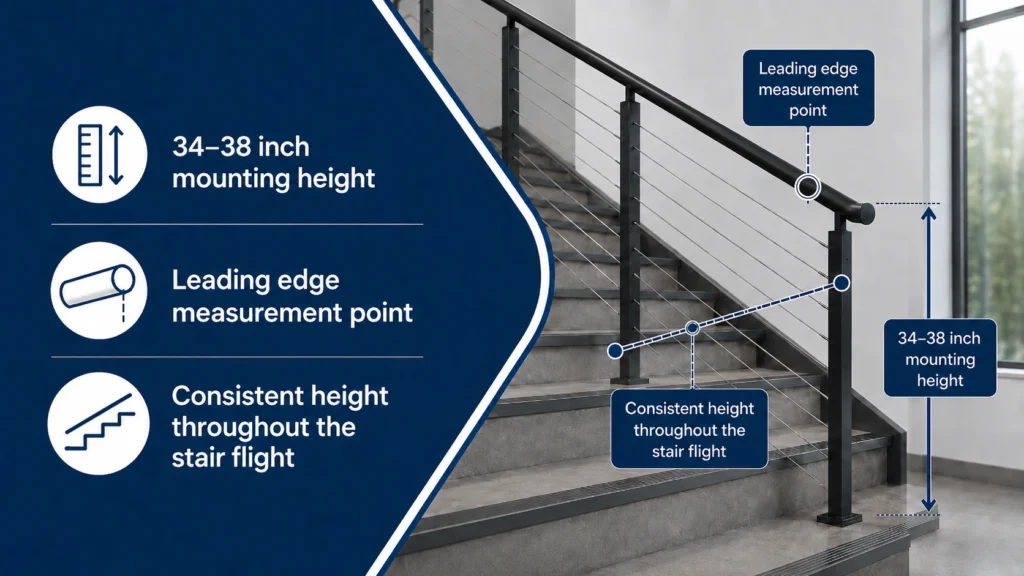
- 34–38 inch mounting height: Handrails must be installed between 34 inches and 38 inches above the stair tread nosing
- Leading edge measurement point: Height must be measured vertically from the leading edge of the stair tread, not from the floor or another surface
- Consistent height throughout the stair flight: The handrail height must remain uniform across the full stair run to maintain reliable user support
These standards exist to support safe movement during both normal use and emergency evacuation. Consistent handrail positioning helps users maintain balance during ascent and descent while reducing the likelihood of slips or instability.
Several common field mistakes can create compliance issues:
- Incorrect measurement reference: Measuring from the wrong point, instead of the stair tread nosing, can place the rail outside the allowed height range
- Inconsistent stair geometry: Variations in tread or riser dimensions can unintentionally create uneven handrail heights across the stair flight
Because of these risks, installers must verify measurements continuously throughout the installation rather than relying on a single reference location.
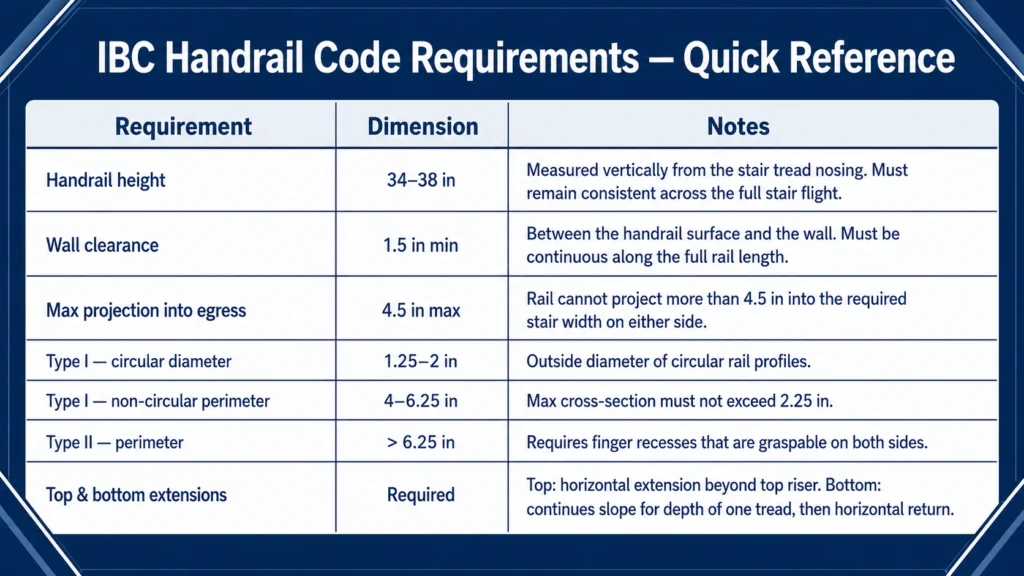
Graspability Standards: Understanding Type I and Type II Handrails
IBC standards require handrails to be graspable so users can maintain continuous control while moving along stairs or ramps. The shape and size of the rail directly affect how securely a person can grip it, especially during emergency evacuation or when additional stability is needed. Because of this, IBC handrail code requirements include detailed dimensional standards for graspability.
Type I Handrails
Type I handrails are the most common configuration used in residential and standard commercial applications. These rails are designed with dimensions that allow users to wrap their fingers securely around the profile.
Primary Type I requirements include:
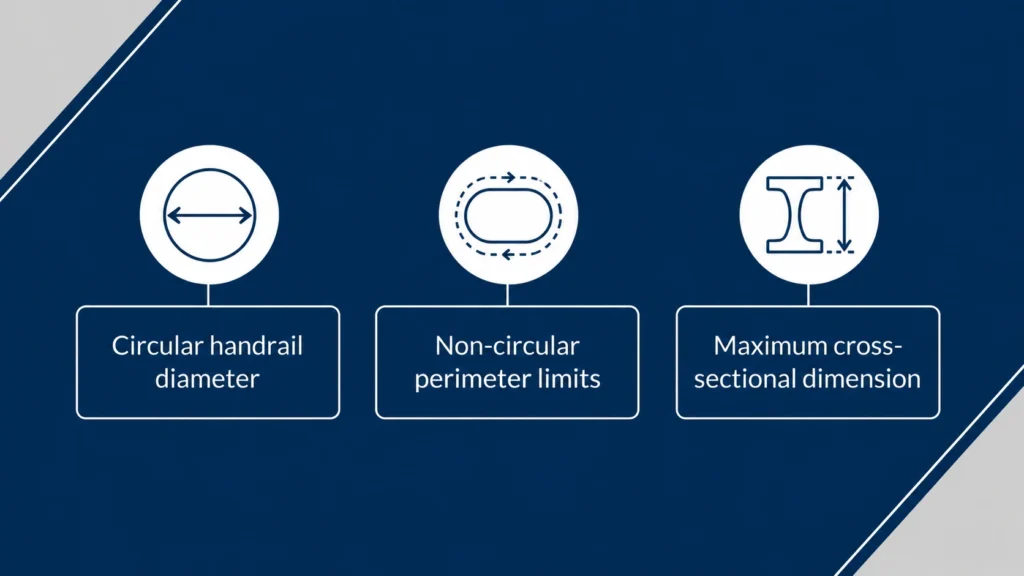
- Circular handrail diameter: Circular rails must have an outside diameter between 1.25 inches and 2 inches
- Non-circular perimeter limits: Non-circular rails must have a perimeter dimension between 4 inches and 6.25 inches
- Maximum cross-sectional dimension: Non-circular profiles cannot exceed 2.25 inches in cross-sectional dimension
These proportions help ensure the rail remains easy to grip during both upward and downward movement.
Type II Handrails
Type II handrails are typically used in larger commercial or high-occupancy environments where wider rail profiles may be required for design, structural, or traffic considerations.
Primary Type II characteristics include:
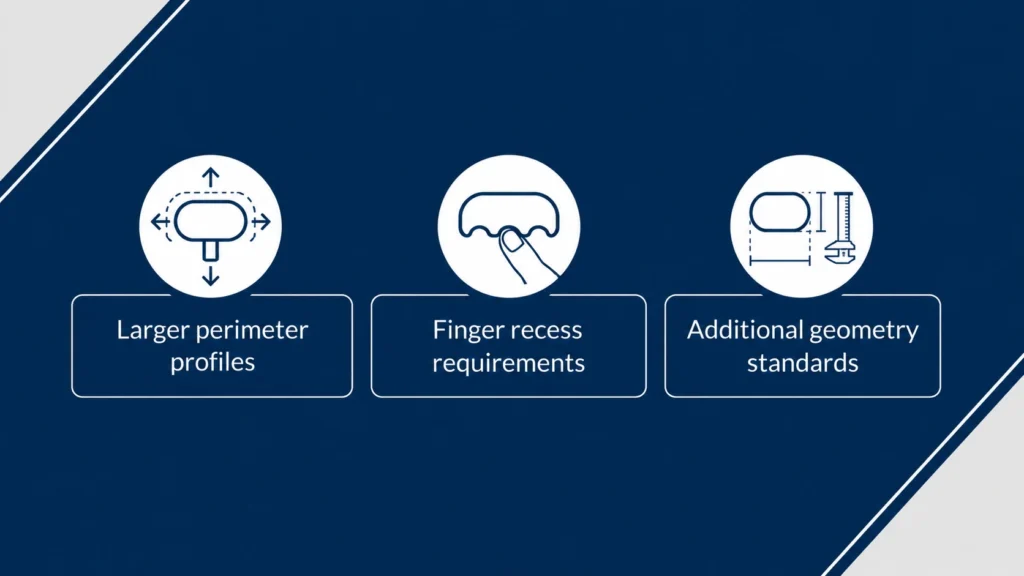
- Larger perimeter profiles: Rails exceeding a 6.25-inch perimeter fall into this category
- Finger recess requirements: The rail must include graspable finger recesses on both sides so users can maintain a secure hold
- Additional geometry standards: Recess depth, spacing, and shape must support continuous hand contact throughout the stair run
These additional geometry requirements allow larger handrails to remain functional and compliant even when the profile exceeds standard grasp dimensions. The purpose of these graspable handrail standards is to ensure users can maintain reliable contact with the rail at all times.
Proper graspability helps:
- Prevent grip slippage: Users can maintain secure control during movement on stairs
- Improve evacuation safety: Stable hand positioning becomes especially important during emergency conditions or low visibility
- Support accessibility requirements: Proper grip geometry improves usability for a wider range of occupants, including individuals with limited strength or mobility
Even a correctly shaped handrail can become non-compliant if spacing and positioning interfere with usability. Clearance between the rail and adjacent surfaces is therefore just as important as the grip profile itself.
IBC Wall Clearance and Handrail Extension Requirements
Even correctly sized handrails can fail inspection if clearance or extension dimensions are incorrect. Under IBC handrail code requirements, spacing and extension details are essential because they directly affect usability, accessibility, and continuous support throughout the stair system.
Required Wall Clearance
IBC standards require sufficient space between the handrail and adjacent surfaces to allow users to maintain a full, uninterrupted grip. Primary wall clearance requirements include:
- Minimum 1.5-inch clearance: There must be at least 1.5 inches of space between the wall and the handrail surface
- Continuous clearance along the rail length: The required spacing must remain consistent throughout the entire handrail run
- No graspability obstructions: Brackets, trim, or adjacent surfaces cannot interfere with the user’s ability to grip the rail fully
This clearance is necessary because users must be able to wrap their fingers around the handrail without restriction. If the rail sits too close to the wall, grip access becomes limited, reducing stability during stair movement.
Several common installation mistakes create compliance problems:
- Mounting brackets that position the rail too close to the wall
- Decorative wall elements interfere with hand access
- Inconsistent spacing caused by uneven wall surfaces or field adjustments
Because graspability and clearance function together, even a properly shaped rail can become non-compliant if users cannot grip it comfortably.
Horizontal Extension Requirements
In addition to clearance, handrail extension requirements are designed to improve user stability during transitions at the top and bottom of stair flights.
Major extension requirements include:
- Top riser extension: Handrails must extend horizontally beyond the top riser before terminating or returning
- Bottom riser continuation: Extensions must continue beyond the bottom riser, typically following the slope for the depth of one tread
- Safe return termination: Extensions must return safely to a wall, post, guard, or walking surface where required to reduce catching hazards
These extensions provide continuous support as users enter or exit the stairway. Abrupt termination points can interrupt balance, especially during descent or emergency evacuation. Proper extension placement improves transition stability and helps maintain predictable hand positioning throughout the full stair sequence.
Protrusion and Stair Width Rules
Handrails improve safety and accessibility, but they cannot reduce the required means-of-egress width of a stairway. Under IBC handrail code requirements, handrail placement must maintain clear occupant movement and preserve the required stair width during normal use and emergency evacuation.
Width and Projection Requirements
Primary dimensional requirements include:
- Maximum 4.5-inch projection: Handrails cannot project more than 4.5 inches into the required width of the stairway or ramp.
- Required egress width preservation: The minimum code-required stair width must remain compliant after the handrail is installed.
- Accessible movement paths: Handrail placement must not interfere with accessibility, evacuation flow, or occupant movement.
Protrusion limits are measured by how far the handrail extends into the required clear width of the stair system. This becomes especially important on narrow stairs and retrofit projects where available space is limited.
Installation and Safety Considerations
Improper handrail projections can create several safety and compliance issues:
- Bottlenecks during emergency evacuation
- Reduced maneuvering space for accessibility
- Increased collision risk in high-occupancy buildings
Dual handrail systems can create additional coordination challenges. Oversized rail profiles, improper brackets, or inconsistent mounting positions may reduce usable width more than expected. Wider stairways may also require intermediate handrails to maintain allowable reach distances across the stairs.
These tolerances demonstrate why precise installation matters as much as proper product selection. Even compliant handrail systems can fail inspection if field installation does not maintain the required clearances and spacing.
Importance of Precise Installation for IBC Handrail Compliance
Meeting IBC handrail code requirements depends on far more than selecting a compliant handrail profile. In many commercial projects, compliance failures occur during installation rather than during design or specification. Small deviations in height, spacing, projection, or extension dimensions can quickly lead to failed inspections and costly rework.
Handrail systems must align with strict dimensional tolerances throughout the entire stair assembly. Stair geometry, wall conditions, mounting hardware, and field coordination all influence whether the final installation remains compliant. Even minor inconsistencies between stair flights or landings can result in measurable violations during inspection.
Several installation-related issues commonly create compliance problems:
- Inconsistent handrail height caused by uneven stair geometry
- Wall brackets reduce the required 1.5-inch clearance
- Improper extension lengths at the top and bottom transitions
- Oversized rail profiles affecting graspability
- Excessive projection reduces the required egress width
Because multiple code requirements work together simultaneously, installers must evaluate the entire stair system rather than treating each dimension independently. Precision becomes especially important in retrofit projects, tight stairwells, and high-occupancy commercial environments where tolerances are limited.
How GSS Supports Compliant Handrail Installation
Achieving compliance with the IBC handrail code requirements requires accurate coordination between design intent and field installation. Even when drawings and specifications are correct, installation tolerances, stair geometry, and site conditions can introduce issues that affect final compliance.
Granite State Specialists (GSS) supports commercial projects with installation teams trained to evaluate and install handrail systems in accordance with strict IBC dimensional standards. This includes experience across commercial stair systems, safety barriers, and other code-driven architectural installations where precision is essential.
The focus is not limited to mounting the rail itself. Compliance depends on coordinating multiple factors simultaneously, including:
- Handrail height consistency throughout the stair flight
- Required wall clearance and graspability access
- Projection limits within the required egress width
- Proper extension geometry at stair transitions
- Alignment with inspection and accessibility requirements
Because these elements interact with one another, installation must be approached as a coordinated system rather than as isolated dimensions.
GSS also works with project teams to support inspection readiness by identifying potential field conflicts before final review. This helps reduce correction work, delays, and compliance risks during project closeout.
Through its broader GSS safety solutions, the company supports commercial environments where code compliance, occupant safety, and long-term durability must work together within demanding architectural conditions.
Commercial Stair Handrail Dimensions and Compliance Reference
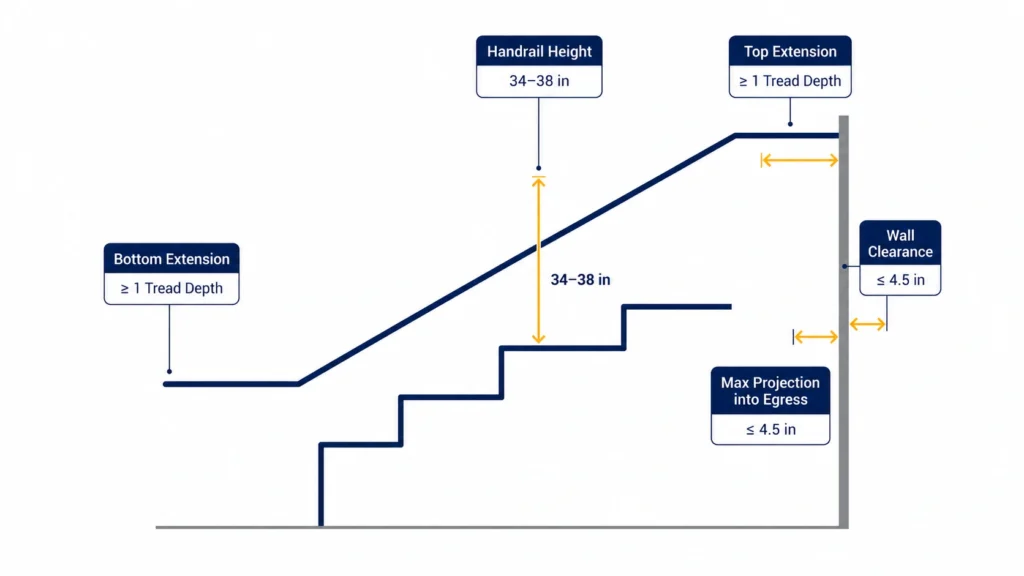
This technical diagram illustrates several core elements required under the IBC handrail code requirements for commercial stair systems.
- 34–38 inch handrail height: The red vertical dimension line shows the required mounting height measured from the leading edge of the stair tread nosing to the top of the handrail. Maintaining this consistent height throughout the stair flight is critical for compliance and user stability.
- 1.5-inch wall clearance: The green dimension indicator indicates the minimum required space between the handrail and the adjacent wall. This clearance ensures users can fully grasp the rail without obstruction.
- Top and bottom extensions: The horizontal sections extending beyond the stair flight illustrate required handrail extensions at both the top and bottom of the stairs. These extensions help users maintain balance as they enter or exit the stair system.
- Leading edge tread measurement point: The diagram references the stair tread nosing, which is the official measurement point used by inspectors when verifying handrail height.
- Projection relationship to stair width: The illustration also reinforces that handrails cannot excessively project into the required means-of-egress width. Under IBC standards, projection is limited to a maximum of 4.5 inches into the stair path.
Visual references like this are important because many handrail compliance issues occur during field installation rather than during design. A properly detailed diagram helps contractors, architects, and inspectors interpret dimensional requirements more consistently.
Common Handrail Compliance Mistakes
Many handrail violations result from field execution issues rather than misunderstandings of the code itself. Small installation inconsistencies can place an otherwise well-designed stair system out of compliance during inspection.
Common compliance mistakes include:
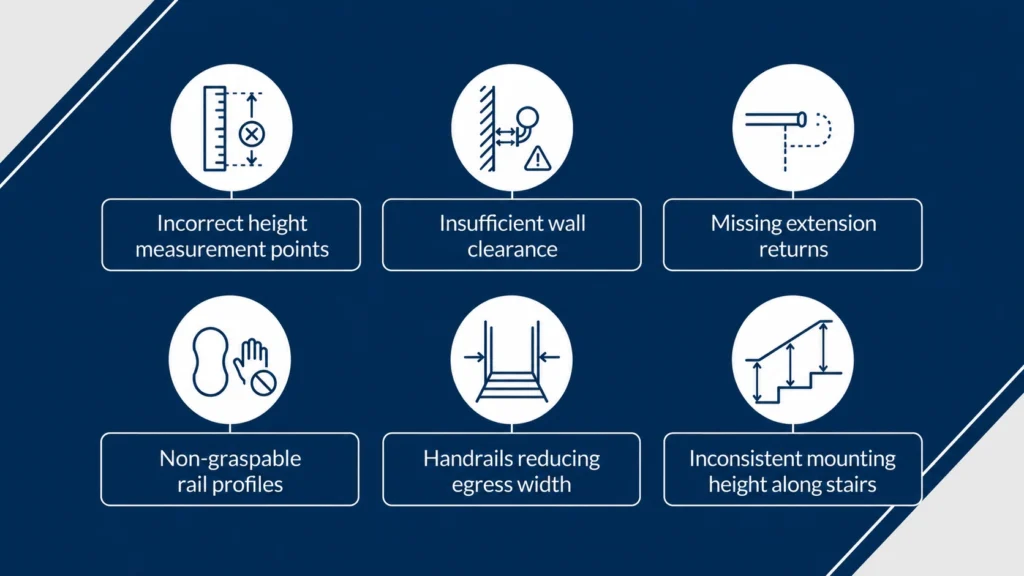
- Incorrect height measurement points: Measuring from the wrong surface instead of the stair tread nosing can place the handrail outside the required 34–38 inch range
- Insufficient wall clearance: Mounting the rail too close to the wall can prevent proper graspability and violate the required 1.5-inch clearance standard
- Missing extension returns: Failing to extend the handrail correctly beyond the top or bottom stair transition can interrupt user support and create inspection issues
- Non-graspable rail profiles: Oversized or improperly shaped rails may prevent users from maintaining a secure grip during movement
- Handrails reducing egress width: Excessive projection into the stair path can reduce the required means-of-egress width and create evacuation concerns
- Inconsistent mounting height along stairs: Variations caused by uneven stair geometry or inaccurate installation can create non-compliant height changes across the stair flight
Many of these issues appear minor during installation but become significant during final inspection. Verifying dimensions consistently throughout the project helps reduce correction work and improves overall stair safety compliance.
Achieve Reliable Stair Safety Compliance with Granite State Specialties

Handrail compliance depends on precision at every stage of the project. Small installation errors involving height, clearance, graspability, or projection can quickly become major compliance risks, affecting inspection approval and occupant safety.
Inspection failures often lead to schedule delays, additional labor costs, and rework that could have been avoided through earlier, proper coordination. Commercial stair systems require careful alignment between design intent, field measurements, and final installation tolerances.
Granite State Specialties supports compliant installation through:
- Height verification: Confirming handrail placement remains within the required 34–38 inch range throughout the stair flight
- Clearance evaluation: Reviewing wall spacing and bracket placement to maintain required graspability access
- Extension coordination: Aligning top and bottom handrail extensions with IBC transition requirements
- Projection management: Helping maintain the required egress width by controlling handrail projection dimensions
- Inspection-focused installation: Coordinating field installation to reduce compliance issues during final review
Contact GSS for expert consultation on compliant handrail and barrier installation that aligns with current IBC handrail code requirements.
Disclaimer:
IBC standards may be modified by state or local jurisdictions. Always verify final project requirements with the Authority Having Jurisdiction (AHJ) and local building officials before installation.
Frequently Asked Questions
1. What are the stair handrail code requirements under the IBC?
IBC stair handrail requirements include a mounting height between 34 inches and 38 inches, a minimum wall clearance of 1.5 inches, proper graspability dimensions, compliant extensions, and limits on projection into the required stair width.
2. What are the IBC guardrail requirements?
IBC guardrail requirements generally apply to elevated walking surfaces where fall protection is necessary. While guardrails and handrails serve different functions, guardrails must meet minimum height and opening limitations, while attached handrails must still comply with graspability and accessibility standards.
3. Do indoor handrail code requirements differ from exterior handrails?
Indoor handrail code requirements follow the same core IBC standards related to height, clearance, graspability, continuity, and extensions. However, material selection and environmental exposure considerations may differ between interior and exterior applications.
4. What is the required clearance between a handrail and the wall?
IBC standards require at least 1.5 inches of clearance between the handrail and the wall to ensure users can maintain a secure, unobstructed grip.
5. What is considered compliant graspability for industrial handrails?
Industrial handrail code requirements still require graspable profiles that support safe use during normal operation and emergency evacuation. Circular rails must generally fall between 1.25 inches and 2 inches in diameter, while larger profiles may require finger recesses to remain compliant.