
A new locker room can look perfect on opening day. The lockers are clean, the finishes are intact, and the material choice fits the project budget. But what happens a few years later?
In a busy athletic facility, lockers deal with wet gear, damp towels, daily impact, constant cleaning, and plenty of wear. Over time, those conditions can expose the limitations of the material you selected.
That’s why the phenolic locker vs. steel locker decision is significant.
Powder-coated steel remains a practical, cost-effective choice for many dry environments. Solid phenolic offers different performance advantages for moisture-prone and high-use spaces.
This blog compares phenolic locker vs. steel locker construction, durability, moisture resistance, maintenance, and lifecycle value to help you choose the right material for your facility.
| Phenolic Locker vs. Steel Locker: Which Is Better? The short answer: in wet, humid, or high-impact spaces, solid phenolic is the better locker. It cannot rust, it resists scratching and heavy impact, and it usually costs less to own over its life. In dry, low-abuse spaces with tight budgets, powder-coated steel is the more economical choice. |
Traditional Steel Lockers
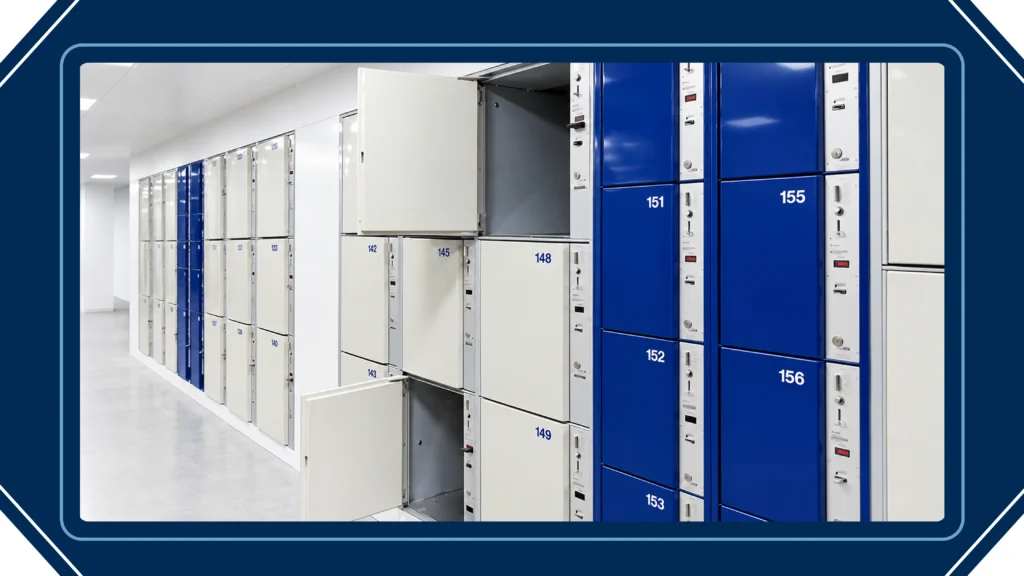
Powder-coated steel lockers have been a commercial standard for decades, and for good reason. They offer rigid construction, a familiar specification, and a relatively low upfront cost. For many dry, lower-abuse environments, those characteristics make steel a practical choice.
Key Advantages
- Lower upfront cost: Steel is generally one of the more economical commercial locker materials.
- Rigid construction: Steel provides a strong, stable enclosure suited to everyday use.
- Familiar specification: Powder-coated steel is widely used in offices, schools, employee areas, and other institutional spaces.
- Durable finish: Powder coating provides a protective surface designed to withstand routine wear, scratches, and abrasion.
Heavy athletic or high-traffic use can also cause dents and surface damage, so the surrounding environment matters when specifying steel lockers.
Solid Phenolic Lockers
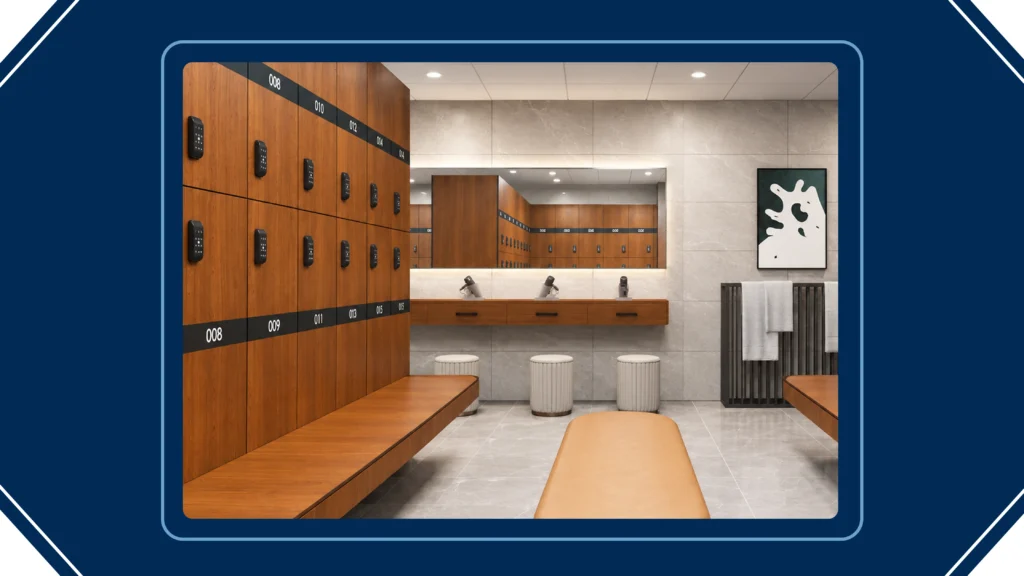
Solid phenolic core lockers take a different approach to durability. Rather than relying on a protective coating over a metal substrate, the locker panels are made from a dense engineered material throughout.
They are built from multiple layers of kraft paper saturated with phenolic resin and compressed under high pressure into a dense, solid panel. Because the material is uniform throughout, there is no thin surface coating to breach.
Key Strengths
- Moisture resistance: Solid phenolic does not absorb water like conventional wood-based materials and does not rust.
- Impact resistance: The dense material is designed to withstand demanding daily use and repeated impact.
- Scratch & graffiti resistance: Phenolic surfaces suit high-traffic environments where surface damage is a concern.
- Low maintenance: The material simplifies routine cleaning and reduces corrosion concerns.
- Wet-environment suitability: These characteristics make solid phenolic a strong option for high-moisture storage solutions in athletic, fitness, aquatic, and recreation facilities.
- Corrosion resistance: Because phenolic does not rust, it suits facilities looking for rust-proof commercial lockers in wet or humid areas.
The key difference: Steel depends on its protective finish to keep moisture away from the underlying metal. Solid phenolic builds moisture resistance into the panel material itself. That distinction matters more as humidity, water exposure, and daily wear increase.
Head-to-Head Comparison: Phenolic Locker vs. Steel Locker
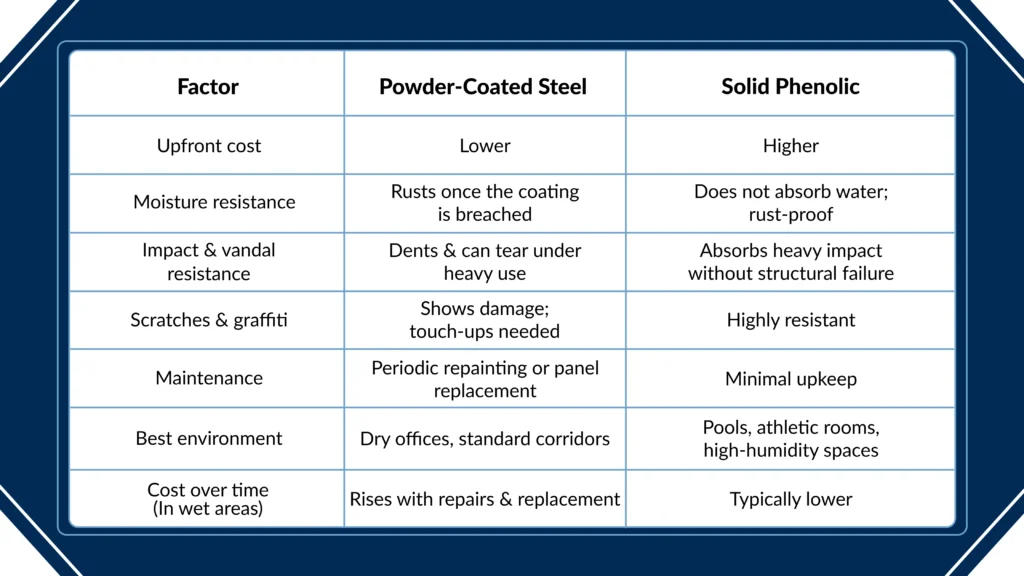
Phenolic Locker vs. Steel Locker: 3 Performance Factors Compared
Three factors decide how each locker performs over time: how it handles moisture, how it holds up to impact, and how much upkeep it needs across its lifespan. Here is how phenolic and steel compare on each.
Moisture Resistance
Metal rusts in humid zones. Phenolic does not absorb water, so pool decks, shower-adjacent rooms, and locker rooms with direct water exposure do not degrade it from the inside. For high-moisture storage solutions, this is the deciding factor.
Impact & Vandal Resistance
Steel dents and can tear under heavy athletic use, and every dent breaks the coating and invites corrosion. Solid phenolic absorbs heavy impacts without structural failure and resists scratching and graffiti, which matters in school athletic rooms and high-traffic public facilities.
Maintenance & Lifespan
Steel units in wet environments need periodic repainting, and eventually panel or full-unit replacement. Phenolic is built for decades of service with minimal upkeep, which is why the phenolic vs. steel locker decision often comes down to lifespan rather than sticker price.
Analyzing Locker Materials by Total Cost of Ownership
Purchase price is only one line in a locker system’s total cost. The Whole Building Design Guide describes life-cycle cost analysis as a way to evaluate total ownership cost, especially when options differ in upfront and operating costs.
That is why life-cycle cost matters in the phenolic locker vs. steel locker decision. In a dry office, steel’s lower price can hold up over its service life. In a humid or high-impact space, repairs, corrosion upkeep, and early replacement can quickly erase that advantage.
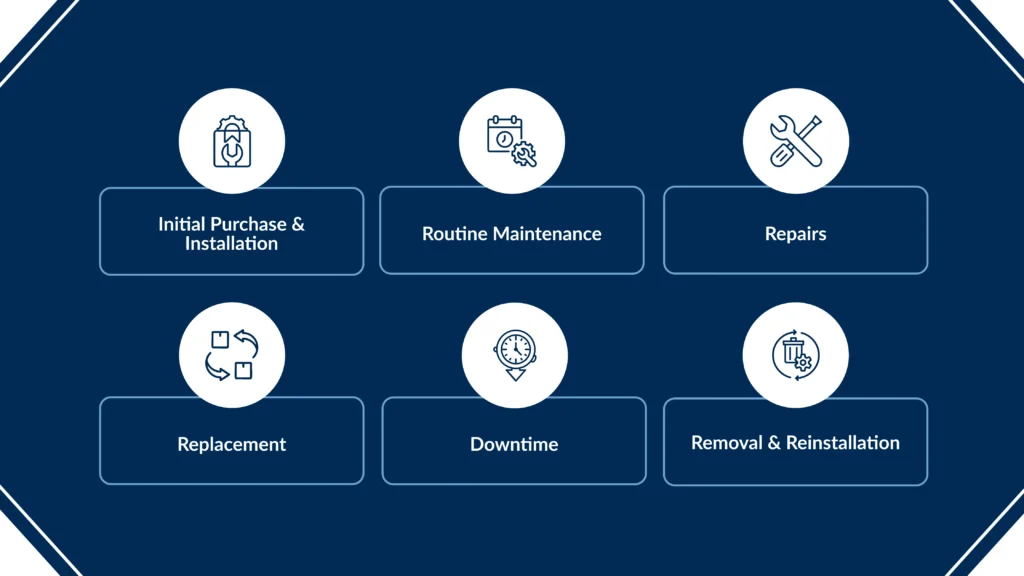
A fair comparison should account for:
- Initial Purchase & Installation: Material, hardware, delivery, and installation costs.
- Routine Maintenance: Cleaning, touch-ups, repainting, and other ongoing upkeep.
- Repairs: Costs associated with damaged panels, doors, hardware, or corrosion.
- Replacement: The cost of replacing individual components or entire locker units.
- Downtime: Labor and operational disruption while damaged lockers are repaired or replaced.
- Removal & Reinstallation: Additional costs when lockers require premature replacement.
Add these up over the same study period for each material, and you get a simple formula adapted from the life-cycle cost method:
| 10-year total cost of ownership = purchase and installation + maintenance + repairs + replacement + downtime + removal |
The full WBDG method also converts future costs to present value. This simplified sum skips that step, which keeps it easy to run on a spreadsheet.
| Pro Tip: When evaluating a phenolic locker vs. a steel locker for high-humidity aquatic facilities or school athletic rooms, calculate the expected 10-year total cost of ownership. Steel may have a lower upfront cost, while phenolic can offer advantages where moisture, corrosion, and heavy daily use increase maintenance requirements. |
Match Locker Materials to Facility Environment
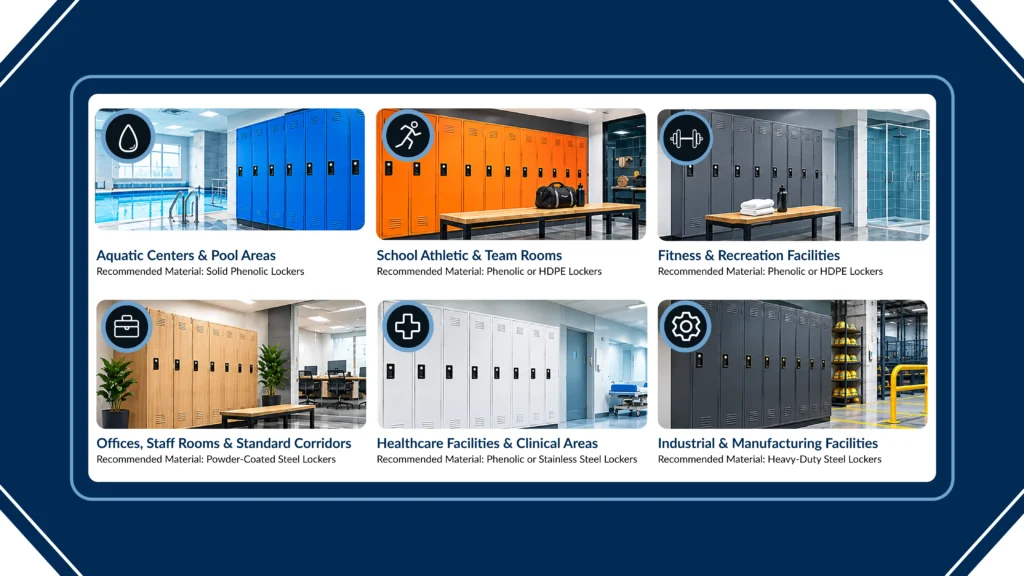
The right locker material depends heavily on the conditions it will face. When comparing phenolic lockers with steel lockers, consider moisture exposure, traffic, impact, cleaning requirements, and expected service life.
- Aquatic centers & pool areas: Frequent humidity and water exposure make moisture-resistant materials such as solid phenolic particularly suitable.
- School athletic & team rooms: Wet gear, heavy daily use, and repeated impact can make durable phenolic systems a practical option.
- Fitness & recreation facilities: Showers and adjacent wet areas can increase humidity, making moisture resistance an important specification consideration.
- Offices, staff rooms & standard corridors: Dry, lower-abuse environments are often well suited to powder-coated steel lockers, particularly where upfront budget is a primary consideration.
The goal is to match the material to the environment rather than selecting a locker system based solely on appearance or initial price.
The GSS Installation Advantage
Selecting the right material is only half of a successful locker project. Granite State Specialties supplies and installs steel, HDPE, phenolic, laminate, and wood lockers from all major brands, with more than 30 years of experience across New England and the United States.
Our team helps clients evaluate facility conditions such as humidity, water exposure, user traffic, and cleaning routines, then designs custom layouts and handles secure, professional installation.
Every GSS commercial locker project starts with how the space will actually be used, so the specification matches the environment.
Get the Right Commercial Locker Solution With GSS

Choosing between phenolic and steel lockers starts with understanding the environment, but the right specification must also account for daily use, maintenance, installation, and long-term value.
GSS helps facility managers, architects, athletic directors, and contractors evaluate these factors and select a locker system suited to the space. Explore our full range of lockers, benches, and shelving. Wet-area storage rarely stands alone. It sits beside restrooms, showers, and corridors where toilet partitions and wall protection face the same moisture and impact, so coordinating them in one scope keeps the finished room consistent.
Ready to invest in storage that stands the test of time? Contact Granite State Specialties for expert guidance on commercial locker selection and turnkey installation.
Frequently Asked Questions
1. What are phenolic lockers?
Phenolic lockers are made from layers of kraft paper saturated with phenolic resin and compressed under high pressure into a dense, solid panel. The result is a locker that does not absorb water, cannot rust, and resists scratches, graffiti, and impact, which is why it is used in locker rooms, pool areas, and athletic facilities.
2. What are the disadvantages of metal lockers?
Metal lockers dent and scratch easily, and once the powder coating is breached, moisture causes rust, especially in humid or wet areas. This can lead to repainting, repairs, and sometimes early replacement, so a lower upfront price can be offset by ongoing costs in demanding environments.
3. Which locker is best for a home in the USA?
For home use, the right locker material depends on where it will be installed and how it will be used. Phenolic and HDPE can suit garages, mudrooms, pool areas, and other moisture-prone spaces, while powder-coated steel can be a practical choice for dry indoor areas where upfront cost is a priority.
4. What type of lock is best for a home locker?
There is no single best option. Keyed locks are simple and need no batteries, but keys can get lost. Combination and electronic keypad locks remove the key, but rely on code discipline and, for electronic models, working batteries. Choose based on who needs access and how valuable the contents are.
5. Are phenolic lockers worth the higher price?
In wet, humid, or high-impact areas, usually yes. When comparing a phenolic locker vs. a steel locker, calculate the 10-year total cost of ownership, including repainting, rust repair, and early replacement. In dry, low-abuse spaces, steel’s lower price often holds up.