
Walk into any commercial restroom, and you’ll notice the partitions right away, even if it’s just a gut feeling. Warped doors, rusted hardware, or graffiti-covered panels quietly signal neglect. Clean, sturdy bathroom stall dividers, on the other hand, make the entire space feel well-managed and intentional.
If you’re a facility manager, architect, or contractor, you already know this isn’t a small decision. The type of toilet partition you choose today will shape maintenance, durability, and user experience for the next 15–25 years.
In this guide, you’ll get a clear breakdown of the most common partition materials and mounting styles, so you can confidently match the right option to your project’s budget, environment, and design goals.
And when you’re ready to move forward, we’ll show you how Granite State Specialties (GSS) simplifies the process by handling both supply and professional installation under one roof.
Popular Question | What Is a Toilet Partition Wall? A toilet partition wall refers to the panels and structural components used to create individual stalls within commercial restrooms. These include doors, pilasters, and divider panels that provide privacy and organization. In modern commercial bathroom stalls, the performance of a toilet partition wall depends on both material and mounting style, making it a fundamental part of overall restroom privacy solutions. |
Why the Right Partition Choice Matters
Commercial bathroom stalls are not one-size-fits-all. A partition that performs brilliantly in a dry corporate lobby can fail within 18 months inside a pool locker room. Fundamental selection factors include:
- Moisture exposure: restrooms adjacent to pools, parks, or kitchens demand moisture-resistant materials
- Traffic volume: high-use facilities (stadiums, schools) need materials that resist impact and vandalism
- Budget: upfront cost vs. total cost of ownership over the partition’s lifespan
- Aesthetics: color range and finish quality matter in hospitality, healthcare, and corporate settings
- ADA compliance: stall dimensions and hardware must meet ADA accessibility standards
Understanding the different types of toilet partitions by material is the foundation of every smart specification decision.
What Are the Most Common Toilet Partition Material Types?
The most common toilet partition material types include powder-coated steel, solid plastic (HDPE), stainless steel, phenolic core, and plastic laminate. Each material offers a different balance of durability, moisture resistance, and cost.
Choosing between these types of toilet partitions depends on how your commercial bathroom stalls will be used and the level of maintenance you want to manage over time.
A Full Breakdown of Toilet Partition Materials
There are five primary toilet partition materials used across commercial restroom projects. Each offers a distinct balance of cost, durability, aesthetics, and moisture resistance.
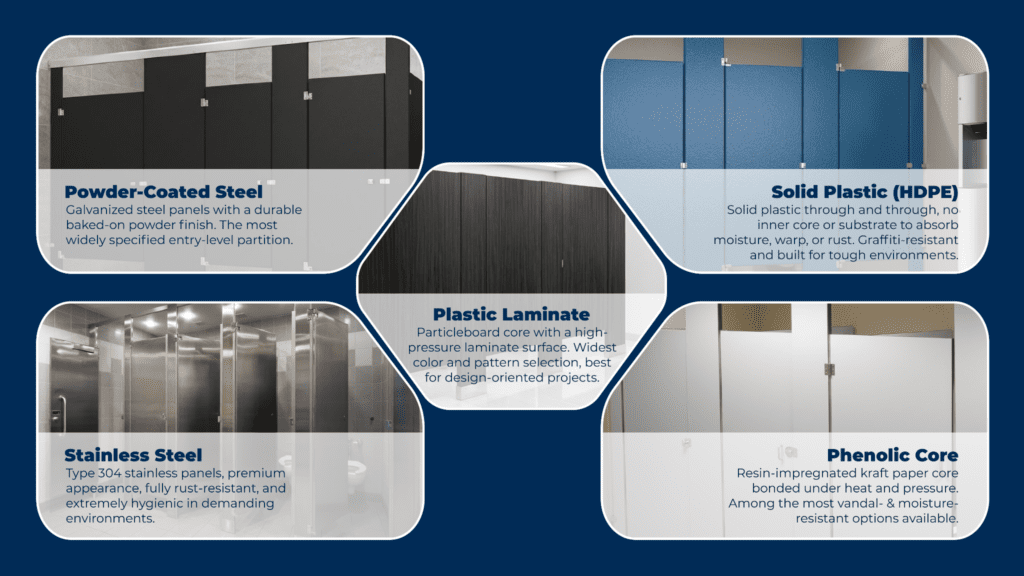
Choosing the Right Toilet Partition Material
Selecting the right partition isn’t just about looks or budget. It’s about how the material performs over time in your specific environment. Here’s a refined breakdown to help you make a confident call.
1. Powder-Coated Steel Partitions
Powder-coated steel remains the most commonly specified option, largely because it strikes a practical balance between cost and performance. Built from galvanized cold-rolled steel and finished with a baked-on coating, these panels resist everyday wear, such as chipping and light corrosion.
They’re easy to source, quick to install, and available in standard color options, making them a dependable choice for many commercial settings. The tradeoff is moisture sensitivity. Over time, especially near the floor, consistent exposure to water can lead to rust.
Best suited for: Offices, retail stores, and low-humidity restrooms
2. Solid Plastic (HDPE) Partitions
HDPE partitions are designed for environments where durability isn’t optional. Because the material is solid throughout, there’s no internal core to absorb moisture, so there’s no rust, swelling, or peeling over time.
They also handle graffiti surprisingly well. Most marks can be wiped clean, and even more serious damage can be sanded out without replacing the panel.
While the upfront cost is higher, the long-term maintenance savings often offset it.
Best suited for: Schools, parks, gyms, aquatic facilities, and high-traffic public restrooms
3. Stainless Steel Partitions
Stainless steel partitions are the go-to when appearance and cleanliness are non-negotiable. Type 304 stainless steel offers a sleek, modern finish and a non-porous surface that naturally resists bacteria and corrosion.
These partitions elevate the overall look of a space while maintaining durability in demanding environments.
They do come at a premium price point, but in high-visibility or prestige settings, the investment often pays off.
Best suited for: Airports, hotels, healthcare facilities, and corporate offices
Popular Question | Why Choose Stainless Steel Toilet Partitions? Stainless steel toilet partitions are a premium choice for commercial bathroom stalls that require both durability and a modern aesthetic. Their non-porous surface resists corrosion, bacteria, and wear over time. |
4. Phenolic Core Partitions
Phenolic partitions are designed to withstand severe wear and tear. Manufactured from layers of resin-infused paper compressed under high heat and pressure, these panels are dense, impact-resistant, and highly moisture-resistant.
They stand up exceptionally well to vandalism, heavy use, and harsh conditions, making them a strong choice for demanding environments.
This is a premium material that delivers long-term reliability where it matters most.
Best suited for: Stadiums, transit hubs, universities, and industrial facilities
Popular Question | What Are Phenolic Toilet Partitions and Where Are They Used? Phenolic toilet partitions are made from layers of resin-infused paper compressed under high pressure, resulting in an extremely dense and durable material. They are designed to withstand heavy use, moisture, and vandalism. These partitions are commonly used in high-traffic environments such as stadiums, schools, and transit facilities, where long-term performance is critical. |
5. Plastic Laminate Partitions
Plastic laminate partitions offer the widest range of design options, from solid colors to woodgrain and textured finishes. Built with a particleboard or MDF core and a laminate surface, they bring a more refined aesthetic to restroom spaces.
They perform best in controlled indoor environments, as excess moisture can affect the core over time. For projects where visual appeal matters but budgets are still a consideration, laminate strikes a smart balance.
Best suited for: Offices, hotels, restaurants, and design-focused interiors with low humidity
Popular Question | Are Metal Toilet Partitions Still a Good Choice? Yes, metal toilet partitions, typically powder-coated steel, remain one of the most widely used options in commercial restroom design. They offer an affordable and practical solution for low- to moderate-traffic environments. While they are cost-effective and easy to install, they perform best in dry environments with limited moisture exposure. |
Types of Toilet Partitions on the Basis of Mounting Styles
Beyond material, the mounting configuration of toilet partitions affects structural stability, cleaning access, and the overall visual character of the restroom. There are three primary systems.
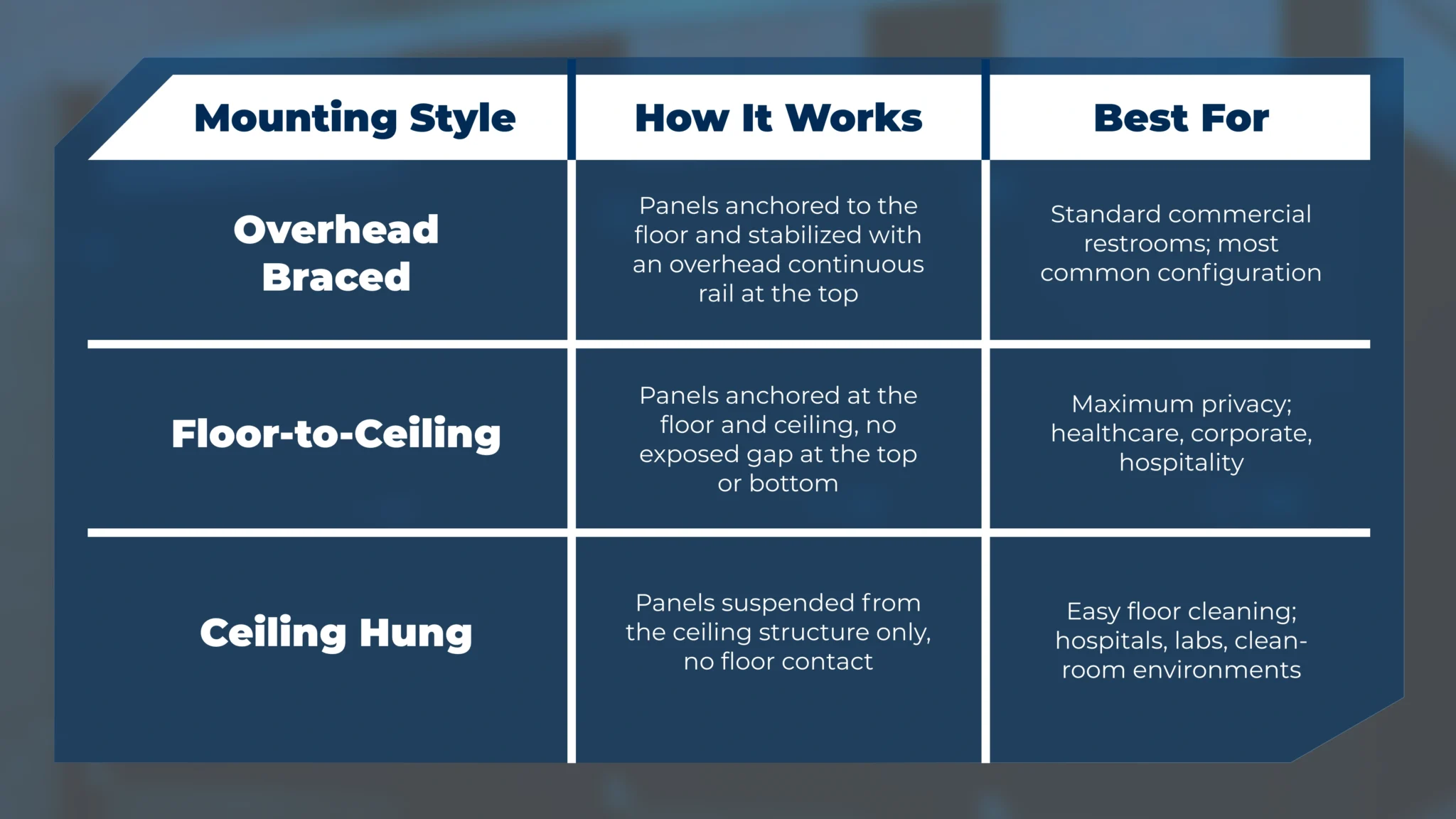
Guide to Choose a Toilet Partition for Your Facility
Use this checklist when comparing types of toilet partitions:
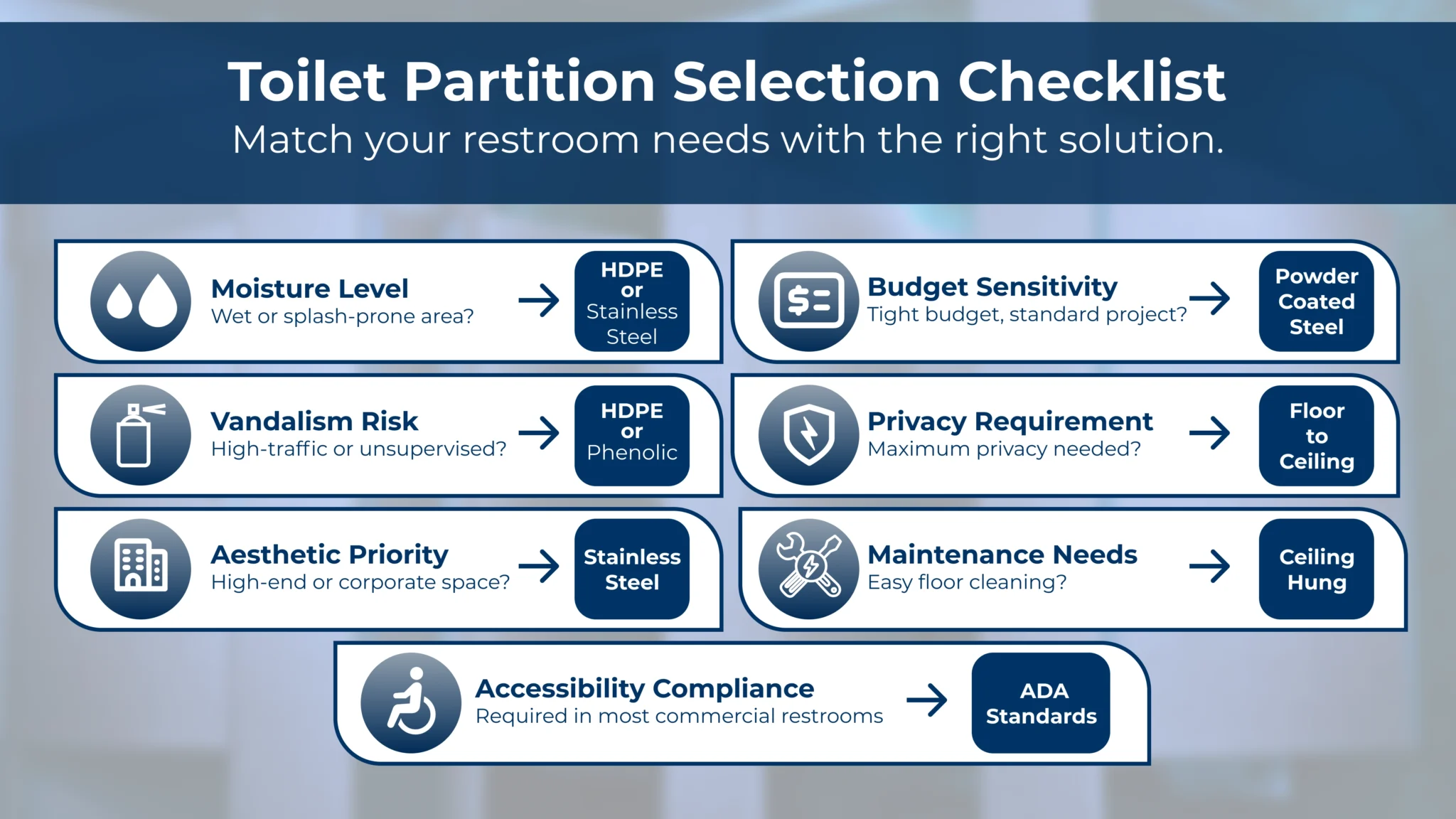
Sourcing the right types of toilet partitions is only half the equation. Improper installation, misaligned hardware, inadequately shimmed panels, and non-ADA-compliant clearances can void manufacturer warranties and expose the owner to liability.
That’s where GSS partitions stand apart from distributors who drop-ship products and leave installation to someone else.
Working with GSS means you are not limited to a single brand. Instead, you get access to multiple trusted manufacturers, allowing you to choose the best solution for your project.
Get the Right Restroom Solution With GSS Partitions
Commercial partition projects move fast. Once specs are locked, there’s little room for second guesses, and the wrong material choice can impact performance, maintenance, and long-term costs.
Granite State Specialties (GSS) handles both product supply and installation, keeping your project seamless from specification to final walkthrough.
From measurements to final adjustments, we manage the entire process while working closely with architects, contractors, and facility teams to match the right material to the environment: HDPE for wet areas, stainless steel for premium spaces, or phenolic for high-impact use.
As an authorized supplier of leading brands like Hadrian, Scranton Products, and Flush Metal, we provide manufacturer-backed specifications, reliable lead times, and warranty documentation you can trust.
- OSHA-certified installation crews (minimum 30-hour training)
- Full-service project management from specification to installation
- Expert guidance across materials and mounting configurations
- Access to top manufacturers with verified product support
Ready to move forward? Request a quote from Granite State Specialties today.
Frequently Asked Questions
1. What are the main types of toilet partition materials?
The five primary toilet partition material types are powder-coated steel, solid plastic (HDPE), stainless steel, phenolic core, and plastic laminate. Each varies in durability, cost, moisture resistance, and design flexibility, making them suitable for different commercial restroom environments.
2. Which toilet partition material is best for moisture-prone areas?
HDPE (solid plastic) and phenolic toilet partitions perform best in wet or high-humidity environments. Both materials resist water, corrosion, swelling, and delamination, making them ideal for locker rooms, pools, and outdoor facilities.
3. What is the most cost-effective type of toilet partition?
Powder-coated steel is the most budget-friendly option. It offers reliable performance at a lower cost, making it a common choice for offices, retail stores, and standard commercial bathroom stalls with controlled humidity.
4. Which toilet partition is best for high-traffic restrooms?
For high-traffic and high-abuse areas, HDPE and phenolic partitions are the top choices. They are highly durable, impact-resistant, and easy to maintain, making them ideal for schools, parks, transit hubs, and public facilities.
5. What are floor-mounted toilet partitions?
Floor-mounted toilet partitions are secured directly to the floor and often paired with overhead bracing for added stability. This is the most common configuration for commercial restroom stalls, offering a strong, cost-effective solution across a wide range of facilities.