Walk into any high-traffic commercial restroom, and the partitions you see are doing a demanding job. They absorb impact from doors slamming open, resist moisture day after day, withstand cleaning chemicals applied on a weekly rotation, and still look presentable years after installation.
The material you choose for those partitions determines how well they hold up and how soon you’ll need to replace them.
Two materials consistently appear in commercial partition decisions: UHMW (ultra-high molecular weight polyethylene) and HDPE (high-density polyethylene). They look similar, come from the same polymer family, and are often compared side by side.
But they perform very differently in real-world commercial applications, and choosing the wrong one can result in unnecessary maintenance costs, premature replacement, and frustrated facility managers.
This guide breaks down exactly how UHMW and HDPE differ, where each performs best, and how to make the right call for your specific project.
What Are UHMW and HDPE?
Both materials are members of the polyethylene family; the thermoplastic polymers built from ethylene monomers. The fundamental difference between them comes down to molecular chain length, and that single structural difference drives most of the performance gap between the two.
UHMW stands for ultra-high molecular weight polyethylene. Its molecular chains are significantly longer than any other polyethylene variant, which gives it exceptional mechanical strength, outstanding wear resistance, and a very low coefficient of friction. Having a low coefficient of friction makes it slippery in mature environments, an ideal surface for most high-moisture, busy partitions.
Moreover, it is one of the toughest plastics available for industrial and commercial applications.
Furthermore, HDPE stands for high-density polyethylene. Its molecular chains are shorter than UHMW’s, which makes it easier and less expensive to produce and machine. It still delivers solid chemical resistance, decent impact tolerance, and UV stability, but it doesn’t match UHMW’s durability under sustained heavy use.
| Think of it this way! HDPE is the proven standard for commercial construction; reliable, cost-effective, and right for most projects. UHMW is the performance tier when the environment pushes beyond what standard conditions require. |
How UHMW vs HDPE Compare Across the Properties, Advantages, and Applications
Now that we’ve established the fundamentals of UHMW and HDPE, it’s time to see how they perform under pressure. While they share a common lineage, their differences become clear when we look at the specifics.
To help you choose the right material for your project, let’s examine a side-by-side comparison across these six critical performance factors:
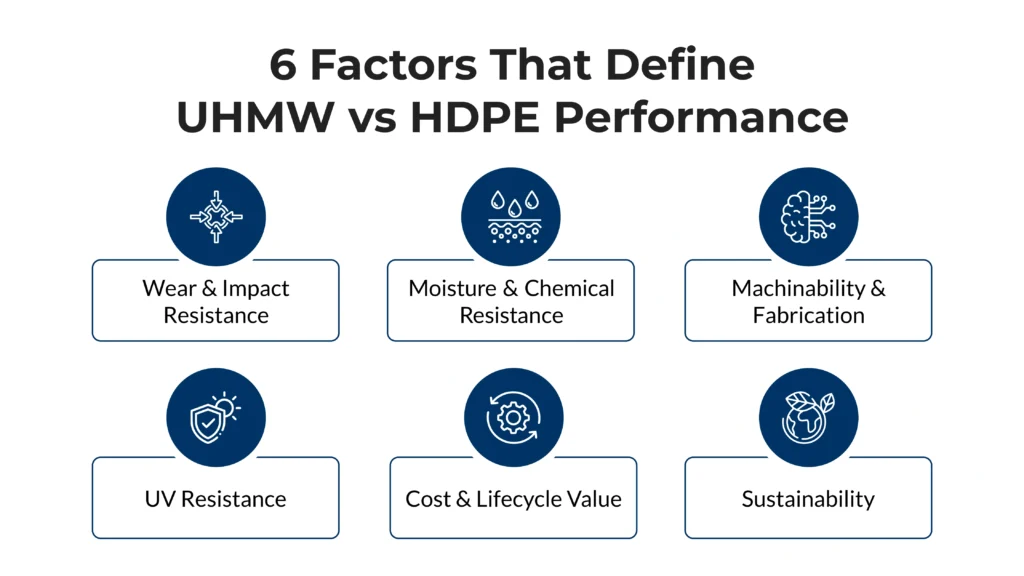
Both materials come from the same polyethylene family, but their performance diverges in ways that matter when partitions are installed in real commercial environments.
Here is how the key differences translate into daily performance, maintenance frequency, and long-term value:
1. Wear and Impact Resistance
| Factor | UHMW | HDPE |
| Surface Wear Resistance | Significantly higher due to longer molecular chains | Good, but wears faster under heavy use |
| Performance in High-Traffic Areas | Maintains surface integrity, edges, and appearance over time | Shows wear sooner in high-traffic environments |
| Impact Handling | Excellent under repeated impact | Reliable in moderate-use environments |
| Best Use Case | Schools, stadiums, transit hubs, high-use restrooms | Standard commercial restrooms with moderate traffic |
2. Moisture and Chemical Resistance
| Factor | UHMW | HDPE |
| Water Absorption | Very low (but not zero) | Zero water absorption |
| Moisture Performance | Excellent in all standard applications | Slight edge in constantly wet environments |
| Resistance to Cleaning Chemicals | Strong resistance to standard cleaning agents | Strong resistance to standard cleaning agents |
| Resistance to Harsh Chemicals | Performs better with industrial-grade or high-frequency disinfectants | Suitable for routine commercial cleaning |
| Best Use Case | Healthcare, institutional, high-cleaning-frequency environments | General commercial restroom environments |
3. Machinability and Fabrication
| Factor | UHMW | HDPE |
| Ease of Cutting & Drilling | Requires specialized tooling and precision | Easy to machine with standard tools |
| Fabrication Speed | Slower due to process requirements | Faster and more production-friendly |
| Customization Flexibility | More complex for custom sizes | Easier for custom fabrication |
| Lead Time Impact | Can extend timelines | Better for tight project schedules |
| Best Use Case | Performance-first projects with flexible timelines | Fast-turn projects or custom layouts |
4. UV Resistance
| Factor | UHMW | HDPE |
| UV Resistance | Excellent | Excellent |
| Performance in Sunlight | Maintains structure and color under exposure | Maintains structure and color under exposure |
| Suitability for Semi-Outdoor Use | Yes | Yes |
| Degradation Risk | Minimal under normal conditions | Minimal under normal conditions |
5. Cost and Lifecycle Value
| Factor | UHMW | HDPE |
| Upfront Cost | Higher | Lower |
| Long-Term Durability | Longer lifespan in high-use environments | Shorter lifespan under heavy use |
| Maintenance Frequency | Lower over time | May increase with wear |
| Lifecycle Value | Higher in demanding environments | Strong value for moderate-use spaces |
| Best Use Case | High-traffic facilities with long-term ROI focus | Budget-conscious projects with standard use |
6. Sustainability
| Factor | UHMW | HDPE |
| Recyclability | Recyclable thermoplastic | Recyclable thermoplastic |
| Recycling Infrastructure | Available but less widespread | More established and accessible |
| Environmental Advantage | Strong alternative to particleboard/metal | Strong alternative to particleboard/metal |
| Best Use Case | Projects with flexible sustainability pathways | Projects with strict recycling requirements |
Choosing the Best Plastic Material for Your Project
The right choice between UHMW vs HDPE comes down to one practical question: what is this partition going to face every single day?
Both materials work. The difference shows up not on day one, but over months and years of real use. The right match delivers an installation that performs as expected for its full service life. The wrong one creates avoidable maintenance and costs down the line.
HDPE Is Ideal for Projects Where Reliability and Value Are the Priority
Consider HDPE when:
- Moderate-traffic environment: a standard office building, medical clinic waiting room, or low-volume retail space where partitions see regular but not punishing use.
- Budget is a primary constraint, and the installation won’t be subjected to extreme daily wear or aggressive cleaning schedules.
- Ease of replacement or modification is a priority, whether for future renovations or phased buildouts.
- You need a reliable, widely available material with a fast lead time that works with every major partition manufacturer and mounting system.
UHMW Is Ideal for Projects Where Long-Term Durability Is Non-Negotiable
Consider UHMW when:
- High-traffic, high-abuse environment: a school, university, sports facility, transit terminal, or industrial workplace where partitions take repeated daily impact.
- The installation will require heavy cleaning, exposure to harsh chemicals, including industrial disinfectants, and frequent pressure washing.
- Longevity and reduced replacement frequency are worth a higher upfront investment.
- The facility has a history of premature wear or damage with standard HDPE partitions and needs a material that can genuinely outlast the conditions.
What This Means for Your Partition Specification
The UHMW vs HDPE decision doesn’t happen in isolation. It connects directly to mounting style, hardware, and expected service life. A UHMW partition in a floor-to-ceiling stadium restroom is a fundamentally different specification from an HDPE overhead-braced system in a professional office buildout.
The right material recommendation comes after understanding the environment, not before. How many people use the restroom daily? What cleaning products does the facility team use?
Has there been a history of damage or vandalism? In many cases, a mixed approach makes sense: HDPE in lower-stress areas, UHMW in the stalls most exposed to heavy use or direct impact.
Getting that call right from the start saves time, reduces maintenance callbacks, and delivers an installation that holds up for the full life of the project. And with that, Granite State Specialties is here for you!
Choose The Right Partition Material For Your Project With Granite State Specialties

Commercial partition projects move fast. Specs get locked early, submittals need to be accurate, and there’s rarely time to revisit a material decision once installation is underway. Getting the UHMW vs HDPE call right from the start isn’t just good practice; it directly affects how the finished space performs and how long it lasts.
Granite State Specialties helps architects, contractors, and facility managers across New England and beyond make those decisions with confidence. With over 30 years of experience supplying and installing commercial toilet partitions in hospitals, universities, schools, and commercial buildouts, the GSS team brings the hands-on product knowledge that turns a specification question into a clear, project-ready answer.
Ready to move forward on your next partition project? Contact Granite State Specialties.
Frequently Asked Questions
1. Is HDPE or UHMW better for commercial restroom partitions?
For most standard commercial restrooms, solid HDPE is the industry-standard choice and performs reliably. UHMW is the better option for high-traffic or high-abuse environments where long-term durability outweighs the higher upfront cost.
2. Can UHMW and HDPE partitions be cleaned with commercial disinfectants?
Yes. Both materials resist the cleaning agents and disinfectants used in standard commercial janitorial routines without degrading the surface.
3. Do plastic partitions like HDPE and UHMW resist moisture better than metal?
Yes. Neither HDPE nor UHMW will rust, swell, or delaminate from exposure to moisture, making solid plastic the preferred choice for wet environments over powder-coated steel or particleboard.
4. Does GSS supply and install both UHMW and HDPE partitions?
Yes. GSS supplies and installs solid plastic partitions in both materials across a full range of mounting configurations, overhead braced, floor-to-ceiling, ceiling hung, floor mounted, and full privacy systems.
5. What factors should you consider when choosing between UHMW and HDPE partitions?
The right choice depends on factors like traffic levels, exposure to moisture and cleaning chemicals, budget, and expected lifespan. High-use environments benefit from UHMW’s durability, while HDPE suits standard applications with cost efficiency.